
HISTORY OF BRITISH GYMNASTICS PRE 1939
1900 - 1939
The second Olympic Games are held in Paris, with the first Welsh gymnast
The second Olympic Games are held in Paris. Lloyd Phillips from Newport, South Wales, takes part along with four other gymnasts: William Pearce from London, William Connor, Broadbec, and Hiatt. Lloyd is recognised as the first Welsh athlete to compete in an Olympic Games.
The Adams' Shield National team competition takes place for the first time. This is the men's club championship, open to all UK clubs. Clubs from Scotland, Ireland and England competed, with Dundee the winner. The event is held at the new premises of the Dolobran Athletic Club, whose membership, having grown to 700, required a new facility, made possible with the help of the Cadbury family.
Gymnastics now takes place in schools and even orphanages.
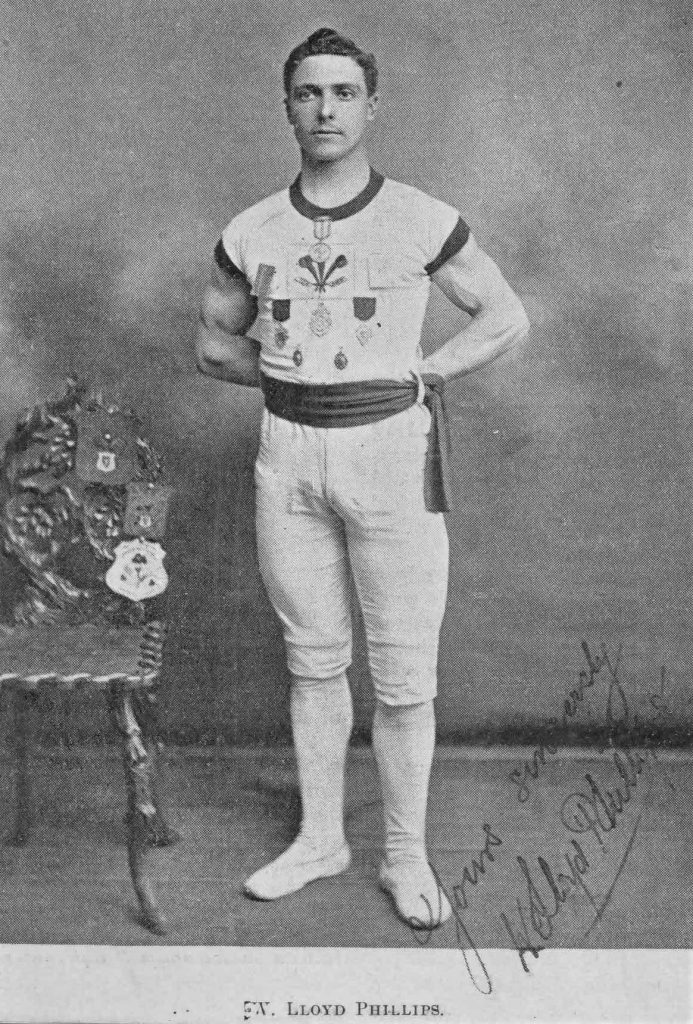
Above - Welsh Olympic Gymnast Lloyd Philips
The Welsh Amateur Gymnastic and Wrestling Association is formed
The Welsh Amateur Gymnastic and Wrestling Association was formed.
Wales holds its first national competition, the Senior Challenge Shield
Wales holds their first competition, the Senior Challenge Shield for men's club teams. The Welsh Shield is still in use today for the men's Welsh Team Championships.
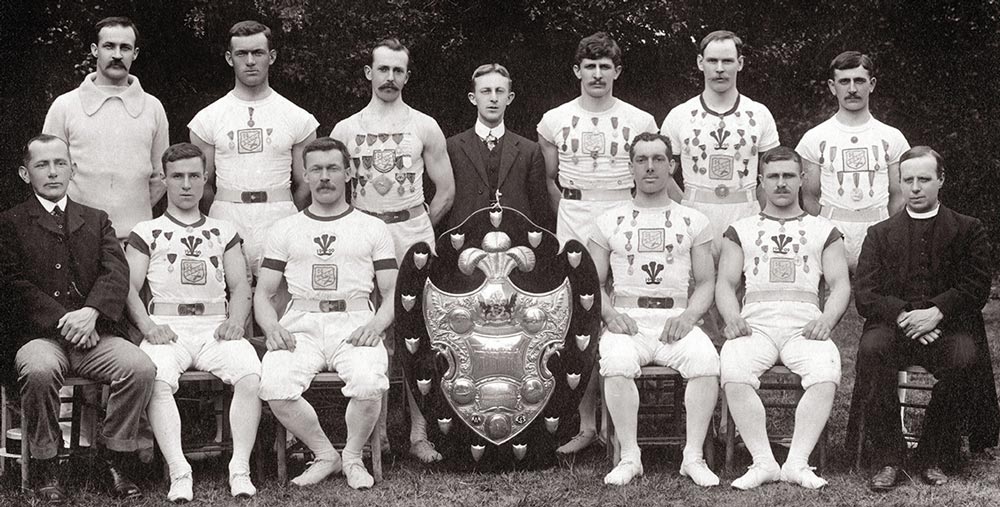
Above - St Saviours winning the Welsh Shield in 1909
The first recorded ladies' club competition is instituted in Birmingham
A ladies' club competition is instituted by the Birmingham & District Amateur Gymnastics Association. Lozells Athletic Club wins this first title - the first recorded ladies' event. The Yorkshire AGA followed in 1906, when Halifax R.E.S. won the Silver Rose Bowl.
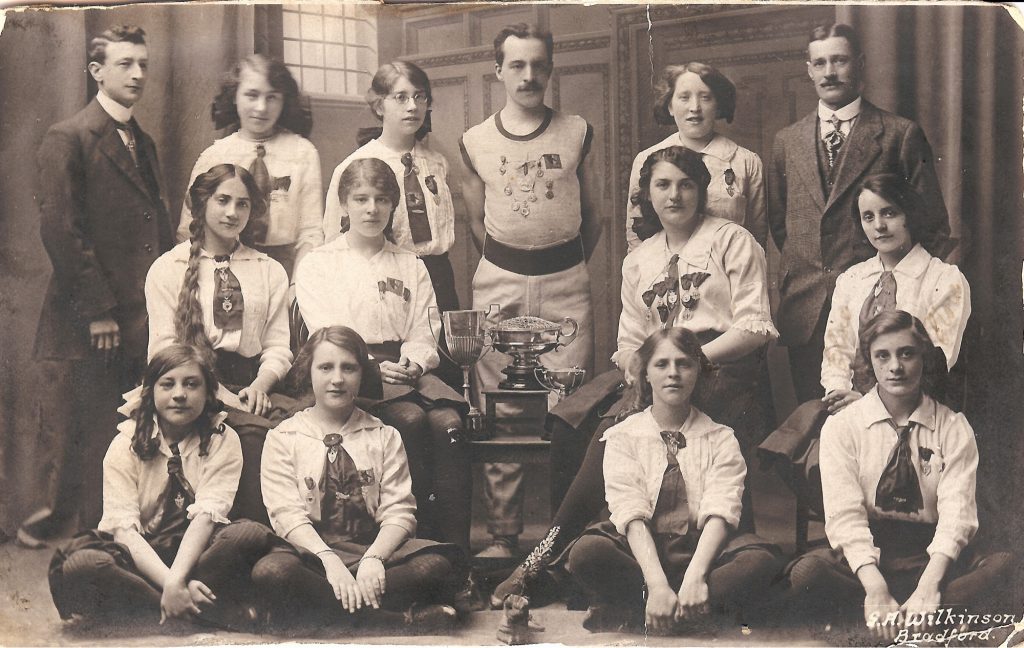
Above - The Bradford Gym Club with the Yorkshire Rose Bowl, circa 1909-1912
Walter Tysall wins Great Britain's first Olympic gymnastics medal, silver, in London
1908 London Olympic Games. Walter Tysall (Birmingham Athletic Institute) wins silver, the first Olympic medal for GB. 45 gymnasts are listed in the team, which came 6th.
The International Gymnastics Board is set up to assist the organisation of the London Games, later becoming the Amateur Gymnastics Federation of Great Britain and Ireland. Lawrence Levy acted as Honorary Secretary and Treasurer until 1911.
The Carnegie Gymnastics Club, Dunfermline, became the proud winners of the Adams Shield and the Scottish Shield. It is recorded at this time by the European Gymnastics Federation (forerunner to the FIG) that Great Britain was made up of 4 federations, with 200 societies and 60,000 members.
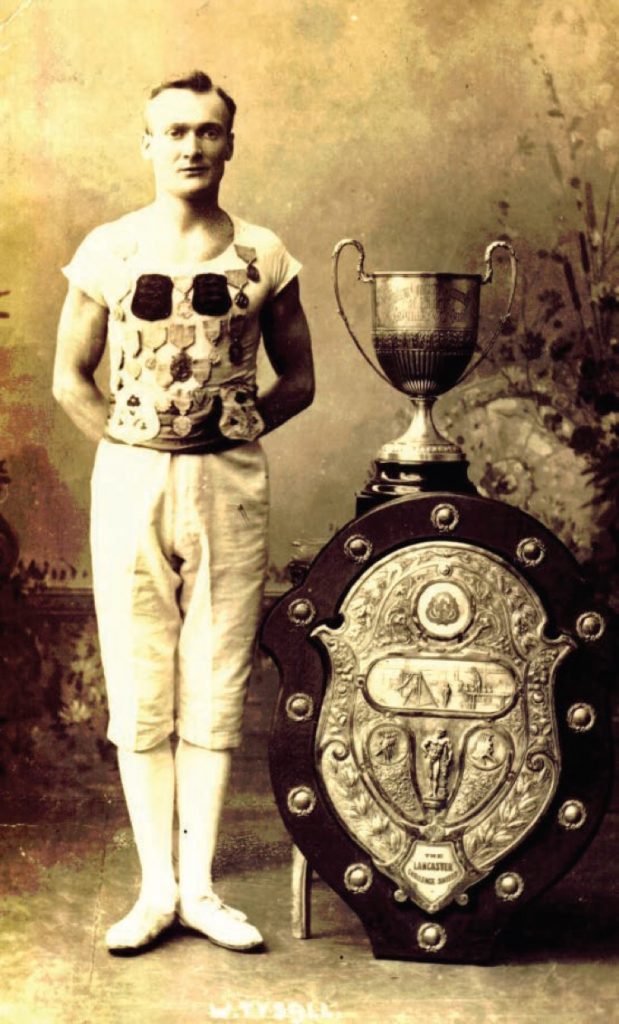
Above - Walter Tysall, 1908 - courtesy of Linda Russell
The English Championships are held in Birmingham
The English Championships are held in Birmingham. 12 gymnasts compete from England and Wales, across 4 disciplines: parallel bars, horizontal bar, pommel horse, and a choice of jump or rope climb. Only one judge officiates, with everything marked out of 20.
The AGA is described as 'the only legislative Gymnastic Body in England recognised by the Amateur Athletic Association', working in cooperation with the Scottish, Irish and Welsh Amateur Gymnastic Associations. The war with the NPRS has ended.
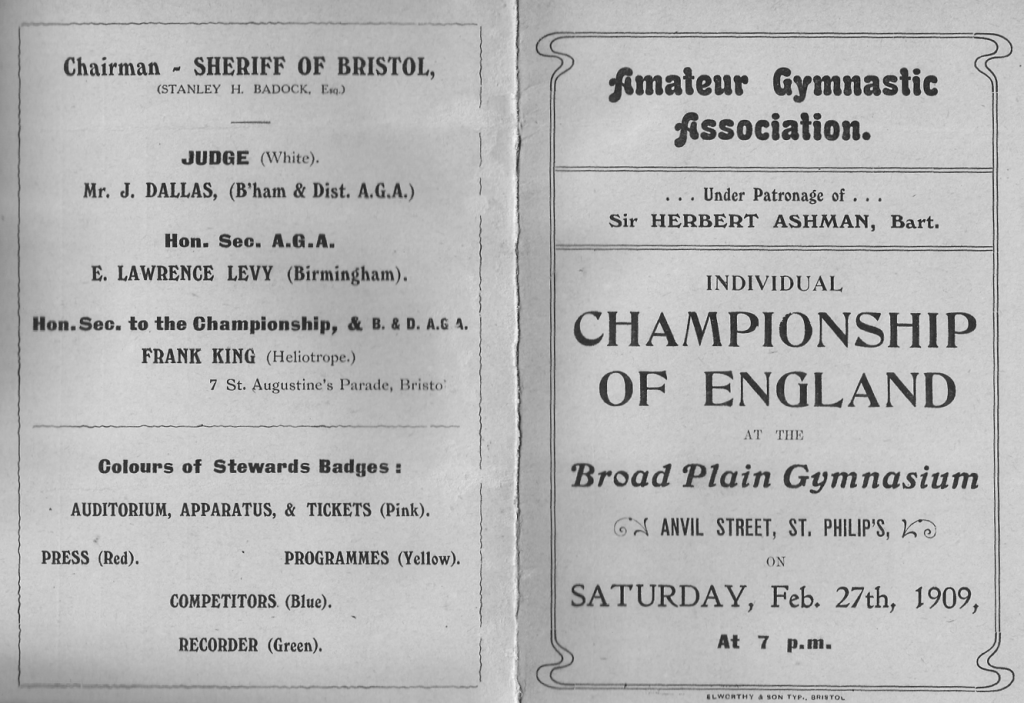
Above - Programme, 1909 English Gymnastics Championships
AGA headquarters move back to London under Charles West
The AGA headquarters move back to London, and Charles West becomes the Honorary Secretary for the next 20 years, seemingly keeping the association going from 1910 to 1930.
The 1910-11 Adams Shield rules require 6 gymnasts per team, club or town, with performance on the apparatus divided between the six so each gymnast performs only 3 events.
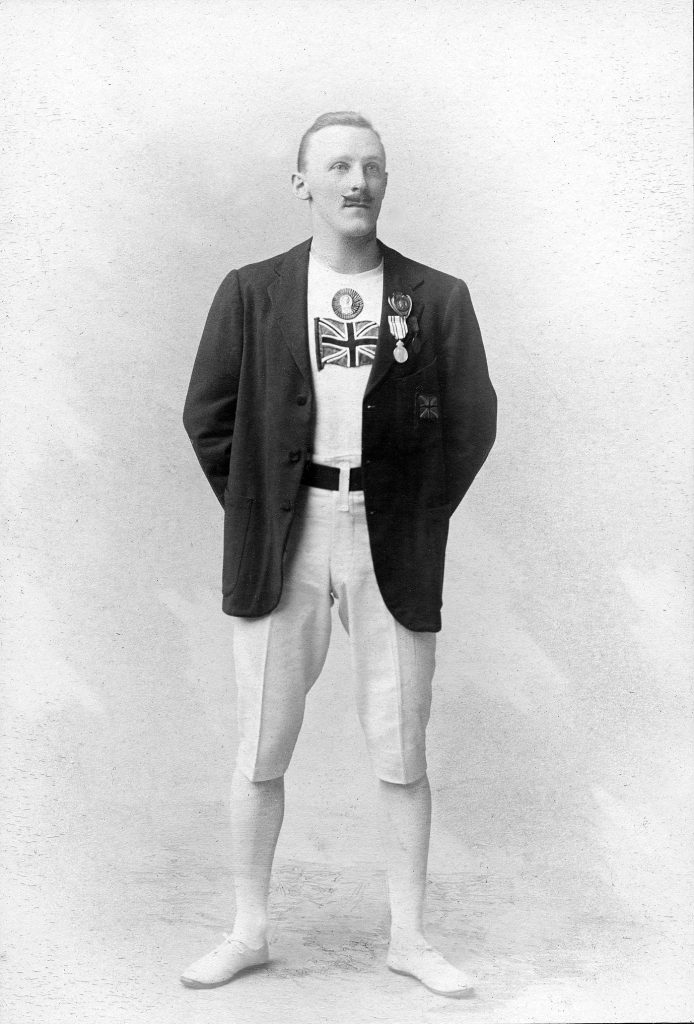
Above - Charles West, honorary secretary of the AGA - photo courtesy John West & ADTRV videos
The International Teams Championships end after Ireland and Scotland can't field teams
Ireland and Scotland are unable to provide teams for the International Teams Championships due to be held in Belfast, ending the annual event, which had run since 1899.
The AGA agrees that for the English Championships, the rope climb will be judged by speed rather than distance: 21 feet in 10 seconds scores 10 points, 12 seconds only 8 points.
At this time, nearly every gym had ropes hanging from the ceiling; the Ushaw College Gym in Durham is no exception.

Above - Ushaw College Gym, Durham, displaying its ropes, 1890s
Team GB wins its first Olympic gymnastics medal, bronze, in Stockholm
Stockholm Olympics, 6th-15th July. Individual competition included High Bar, Parallel Bars, Pommel Horse and Rings. Team GB fields 23 men.
Men's Team - bronze; the first British team to win a medal at the Olympics. The team officials were Charles West, Honorary Secretary, Rudolf Oberholzer, coach, and P W Nicholson, assistant honorary secretary.
Several gymnasts were suspended this year for breaching amateur rules; a section had to be signed by each competitor to declare their amateur status.
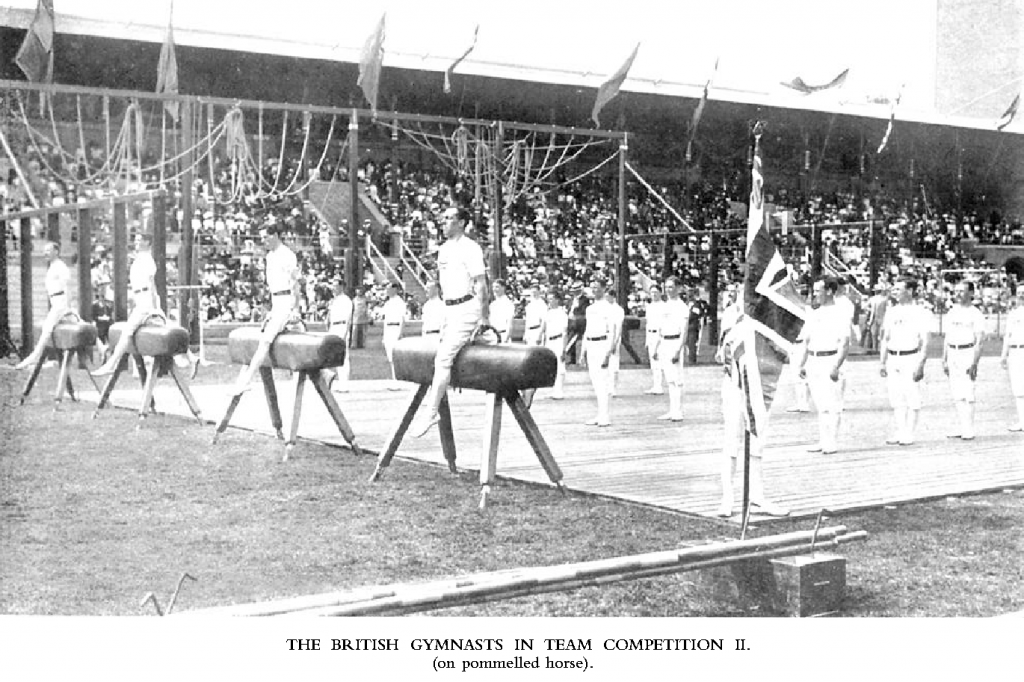
Above - 1912 Olympic Games - British men on the pommel horses
The AGA introduces a capitation scheme and takes on the role of governing body
A 1d subscription per gymnast is approved by the AGA Council, the Capitation Scheme, estimated to bring in a total of £36 with monies from Scotland, Ireland and Wales.
The minutes record that the AGA be recognised by all four home countries as the body governing gymnastics in all Olympic Games events and other international matters, with a board formed of 2 delegates from each country. This is when the AGA takes on the role of the governing body for Great Britain and Ireland.
A British team takes part in the 12th Turnfest in Leipzig, alongside 62,700 participants.
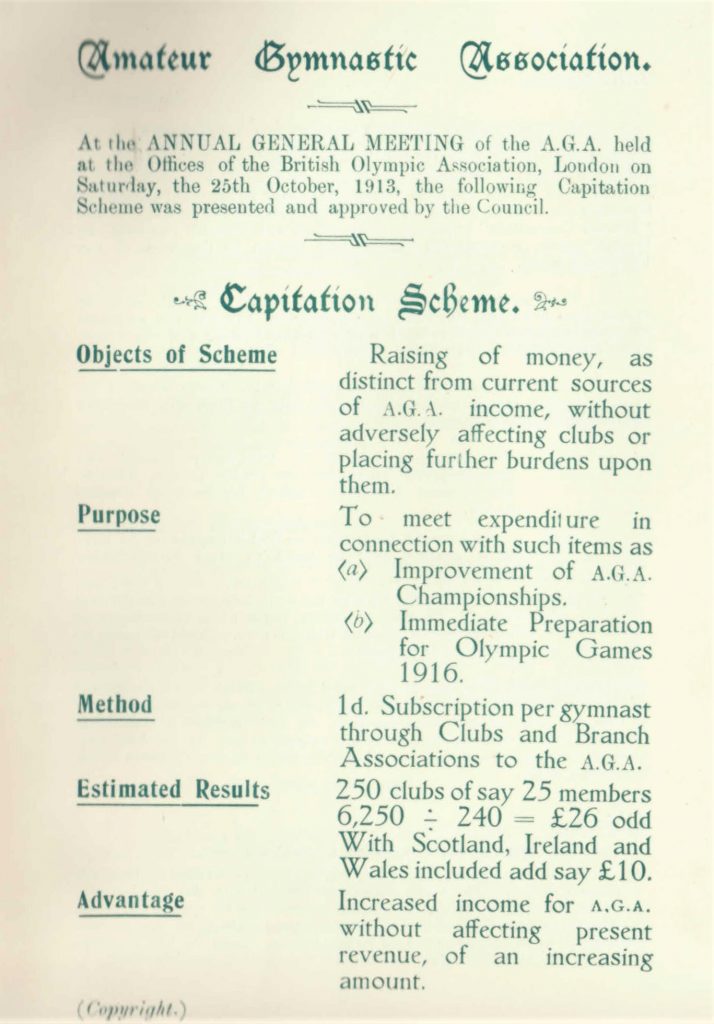
Above - The 1913 Capitation Scheme
War is declared and the AGA calls on clubs to help train recruits
War is declared - the AGA members respond. A letter from the AGA to all Branch secretaries urges that special facilities be afforded for training men who have offered themselves for service but were rejected for insufficient physical development, pointing out that the gymnasium is one of the best places to obtain physical fitness.
Bromley Gym Club writes: "All our men and their instructor joined up, our boys and girls filling places in town or going to work on Munitions, other members joining the special constabulary. The club itself was kept going by our Ladies section."
With the outbreak of war, the German Gymnasium in London closed its doors, never to open again as a gymnasium. German men living in the country were interned, the biggest camp being Knockaloe on the Isle of Man, where sport was encouraged and gymnasts were once more allowed to practise.
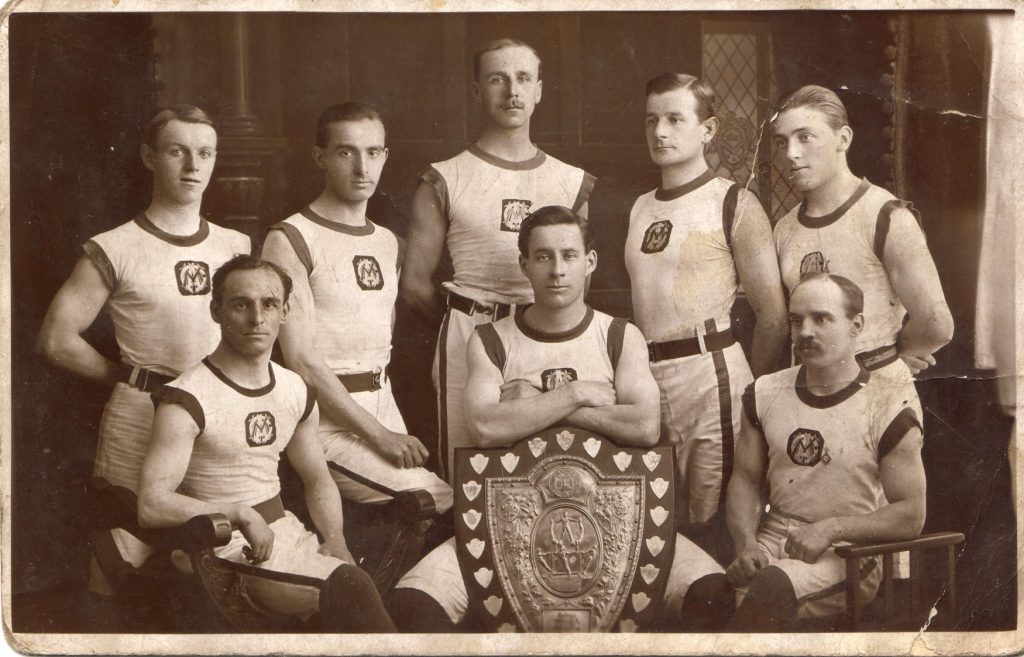
Above - Frank Bellamy, killed in WWI, seen back right with his team - photo courtesy of the Bellamy family
The AGA suspends its competition programme for the duration of the war
It is unanimously agreed by the AGA that there would be no attempt to run the usual competition programme during the war crisis. The AGM is held at 80 Gracechurch Street, London, with a balance of £2 4 shillings and 5 pence.
The AGM report concludes: "The large number of active members of affiliated clubs of all our Branches having joined His Majesty's Forces, it has been quite impracticable to carry on gymnastic work as energetically as one had hoped for, in many instances 90 percent of the members of individual clubs having responded to their Country's call."
Peace at last - the AGA holds its first post-war meeting
1919, peace at last. The first meeting following the war is held at 41 Threadneedle Street, London, on 25th June. The chairman, Mr Mears, records with deep regret the death of committee member Mr W Woodman, killed in action in Palestine on 9th December 1917.
Great Britain's men's team competes at the Antwerp Olympics
The Antwerp Olympics. The British Men's Team competed.
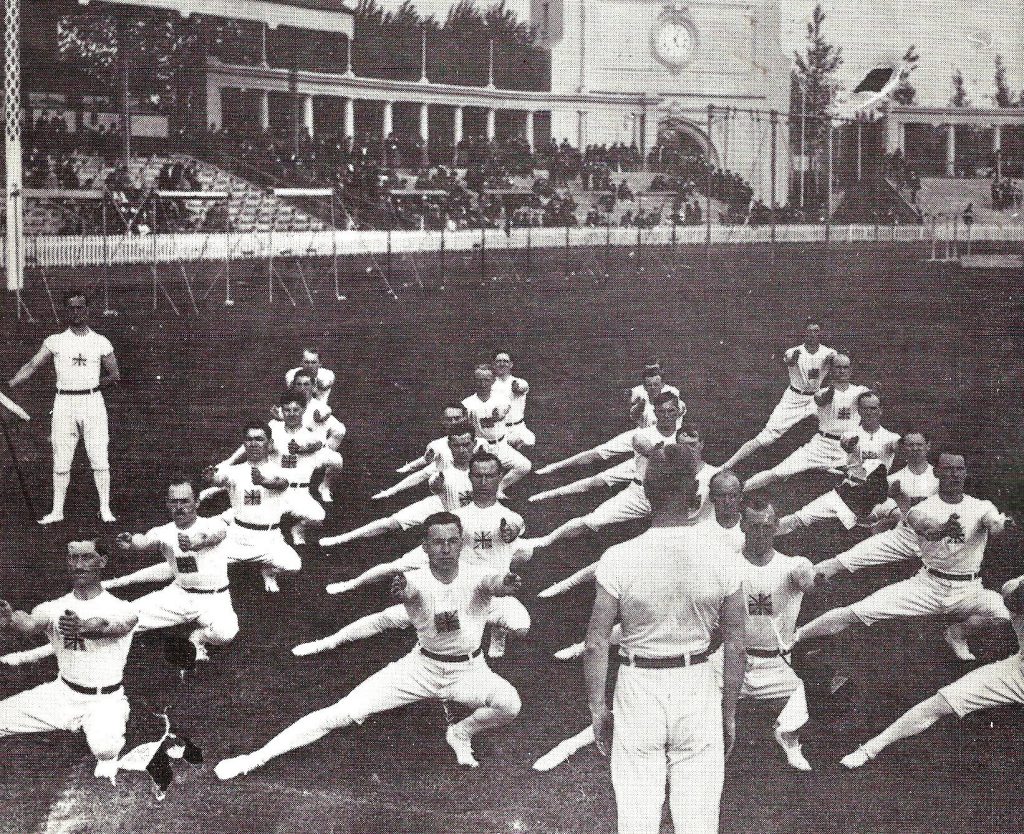
Above - GB's 1920 Antwerp squad of 24 performing a group exercise, with coach JJ Cook at front
The governing body is renamed the International Gymnastics Federation, the FIG
The 11th Congress of the European Gymnastics Federation is held in Brussels. The Americans ask to join the only international body for gymnastics. The name of the Federation is changed to the International Gymnastics Federation, the FIG.
On 21st May, a demonstration of gymnastics is given at Queen's Club, West Kensington. Nearly 1000 gymnasts take part, with HRH The Duke of York, patron of the AGA, in attendance.
Above - The FIG logo
The first Women's Team Championships are held in London
London and Metropolitan Counties AGA publish The Gymnast magazine; after 4 issues the AGA takes it on.
The first Women's Team Championships are held at the Northampton Polytechnic Institute, Clerkenwell, London. The Marchioness of Bute presents her trophy to the winners, the Northampton Polytechnic Institute, with Bradford Gymnastics Club 2nd and Catford Gym Club 3rd.
In May, a British party of approximately 180 gymnasts, 30 of them women, attend the 45th French Federal Fete at Rouen, representing Wales, Scotland and England. The Duke of York contributes £200 to the British team.
Above - The NPI with the Duchess of Bute trophy and trainer Rudolf Oberholzer, winning the first Women's British Team Championships, 1923
The first British Championships for women are held in Swindon
1924 Olympics, Paris. The British Men's Team competed, coming 6th out of 8 teams.
First British Championships held for women, in Swindon. A trophy is donated by the Honorary Secretary's wife; the Mrs Charles West trophy is still awarded each year to the women's British champion. Dorothy Billson of Bradford wins, competing in set and voluntary exercises on parallel bars, swinging rings, vault with pommels, plus Indian club swinging.
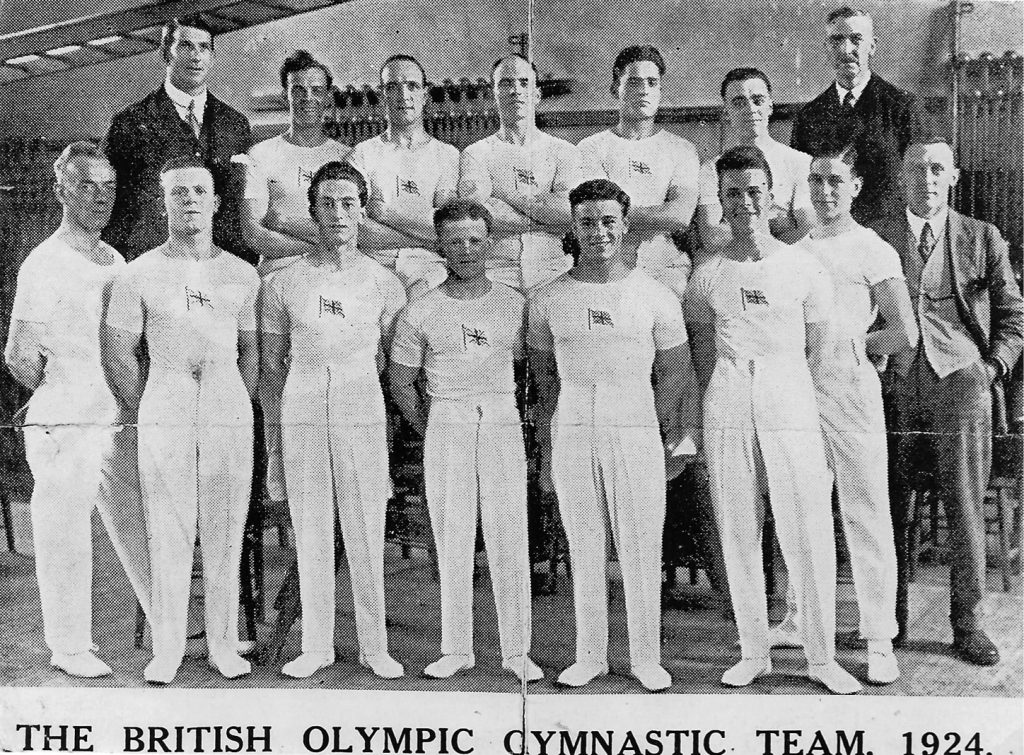
Above - Dorothy Billson, first British Women's Champion, 1924
The rules for the Women's and Men's English Championships are set out
At the Women's 2nd English Championships, gymnasts compete on Parallel Bars, Swinging Rings (the set exercise containing a still section), Pommel Horse, and 1½ minutes of Free Exercise without hand apparatus.
In the men's English Championships, gymnasts compete on Parallel Bars, Horizontal Bar, Pommel Horse, Rings and Long Horse Vault, with a time limit of no more than 2 minutes per exercise, except pommels at a maximum of 1 minute.
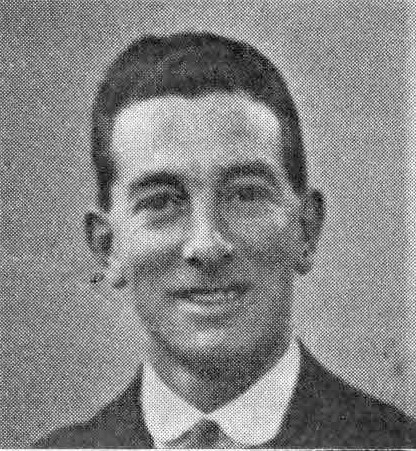
Above - 1925 British Champion H.J. Finchett from Birmingham YMCA
Women compete in Olympic gymnastics for the first time, and GB wins bronze
The Olympics are held in Amsterdam. Women compete in gymnastics for the first time. The GB Ladies Team (12 gymnasts) wins bronze in the team event, the only event open to women. They subsequently receive bad press for 'baring too much of their legs', albeit wearing tights.
It's decided that all men competing in the Individual Championships must use the steel bar provided; there will be no wooden bar from now on.
Arthur Whitford of Swansea YMCA & Sketty wins his first national title, the first of 10.
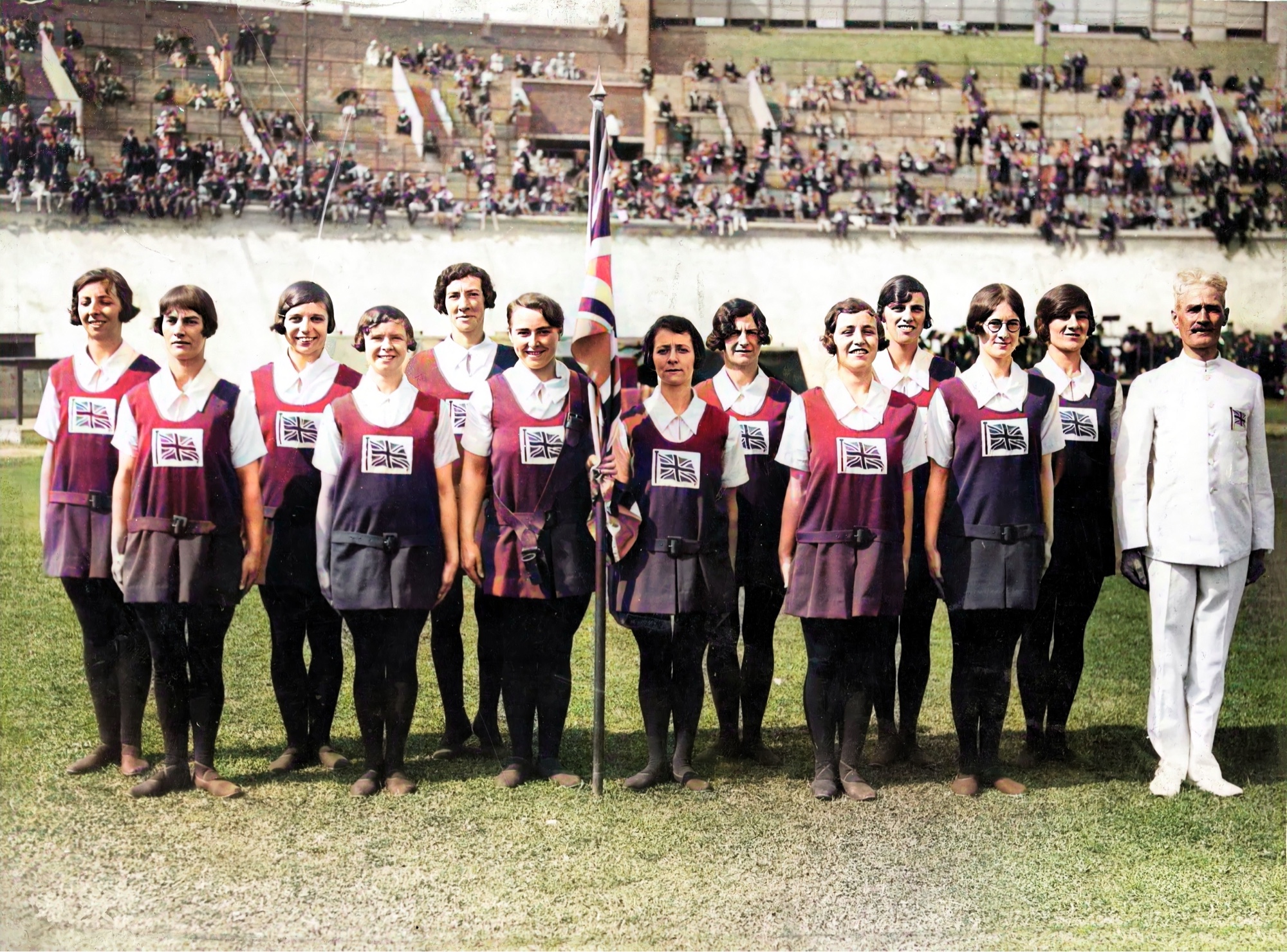
Above - The 1928 GB Olympic Women's Gymnastics Team in Amsterdam - photo BG Archive
Rules on women's competition dress are set out
The question of women's dress is spoken of again. Women must wear knickers to cover the top of their stockings with a long-sleeved loose sweater to cover their seat when standing, or a long-sleeved blouse with a short tunic and knickers. Tights without knickers are not permitted.
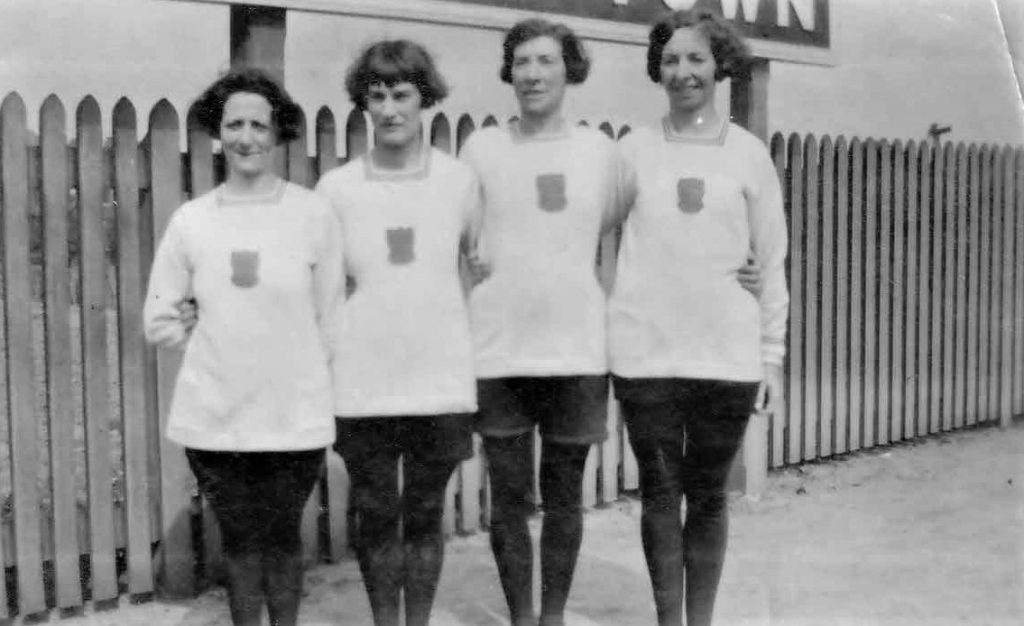
Above - The NPI ladies with their new look - 'Our first shorts. Very daring in them those days,' Lucy Desmond wrote on the back of this photo
Mrs Metson becomes the first woman to judge a national championships
At the ladies' team championships, Mrs Metson of London is one of the judges; she is the first lady to judge a national championships.
Britain sits out gymnastics at the Los Angeles Olympics over cost
In January, it is confirmed that there would be no competition for women at the Los Angeles Olympics; there will be exhibition work for women of 16-plus only, and it would not be possible for the UK to take part due to the cost. It was decided that the men would not compete either, also due to cost.
At the AGM, executive members are usually voted in en bloc. Mr Billson, husband of Dorothy Billson, the first lady champion, nominated Miss J M Shaw for the executive. Voting took place, but there was no change in the usual members: men only.
A national team competes against Holland and Belgium in Rotterdam
During May, a national team competes against Holland and Belgium in Rotterdam: Stanley Humphreys, T Parkinson, W Walsh and George Whitaker from England, plus Arthur Whitford and Harold Davies from Wales. The result: Holland 603.75, Belgium 572.50, England 538.5.
The Adams Shield is repaired and renovated with the addition of bands on the front to accommodate future years' engraving.
The hall where we competed held about 4,000 persons. It was the longest competition I was ever in, starting at 7.30 pm, and I remember it was about 1 am before I got dressed, after keeping up the prestige of old England by showing what good losers we were.
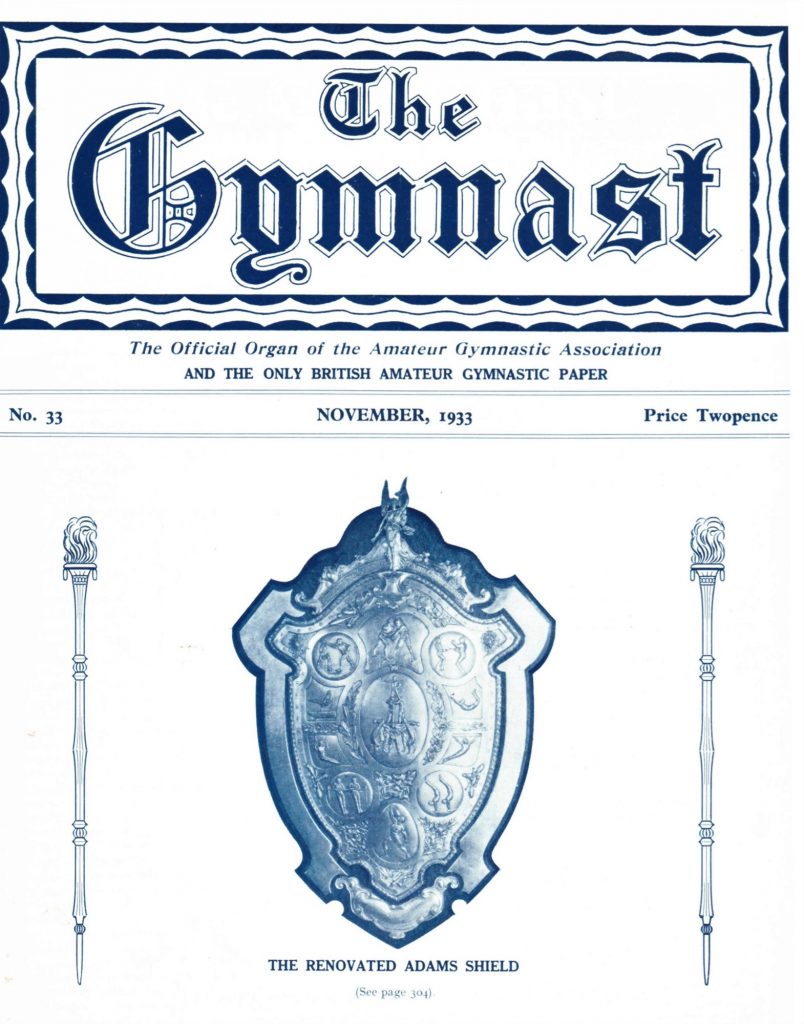
Above - The renovated Adams Shield, as featured in The Gymnast magazine, 1933
The FIG affiliation fee is raised twentyfold
The affiliation payment to the International Gymnastics Federation is raised from 100 francs to 2000 francs. The FIG's 100-year celebration book, published in 1988, records that Great Britain did not join the FIG until 1936.
Bovril sponsors the English Championships, likely the sport's first sponsorship
The English Championships are held at the Ardwick Lads' and Men's Club in Manchester. Bovril is supplied to all competitors in what is likely the first sponsorship of a gymnastics event.
The British men train for two weeks at Bishop Vesey Grammar School in Sutton Coldfield, mapped out by Olympic coach Walter Standish of Swansea and assisted by Alfred Bradley, in preparation for a team to go to the 1936 Berlin Olympics.
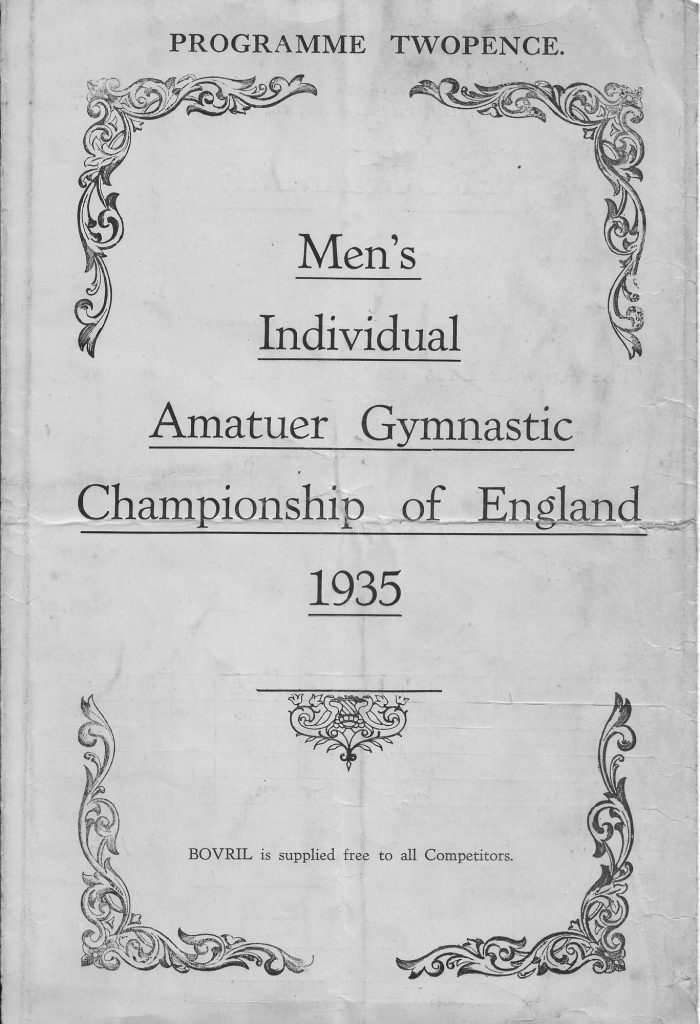
Above - Poster for the 1935 British Gymnastics Championships, with sponsorship from Bovril
Team GB competes at the Berlin Olympics, the last before the war
Team GB competes at the 1936 Berlin Olympics, the last Olympics before the outbreak of World War II.
The Gymnast magazine ceases publication this year.
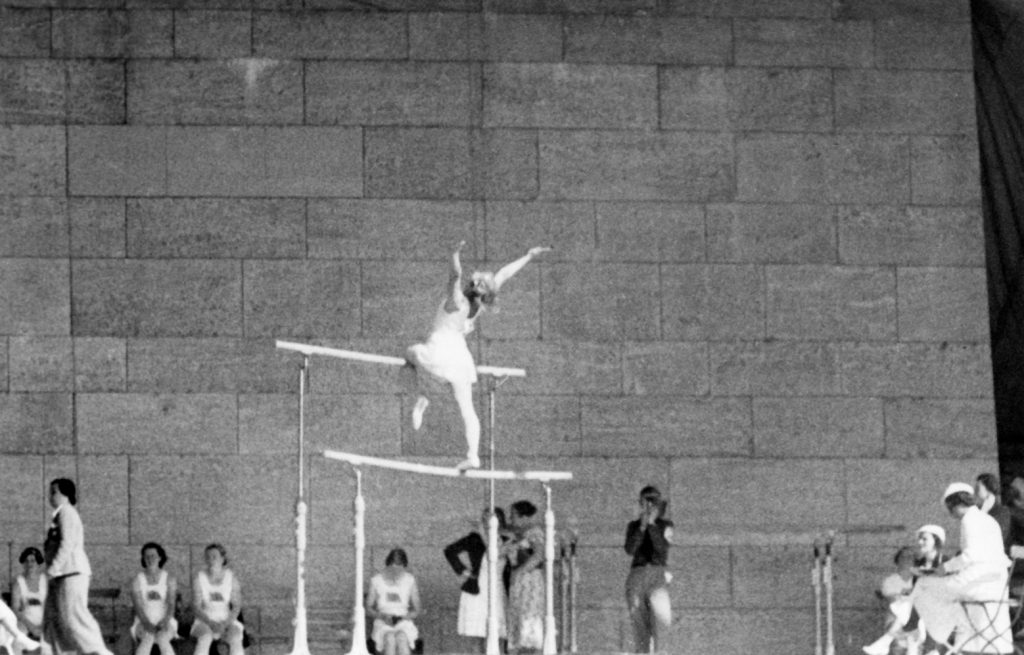
Above - Edna Earl, part of the British team, competing on the Uneven Bars at the 1936 Olympics
The AGA's annual report lists nine London members, all Vice Presidents men
The annual report presented to the AGM shows nine London members, one of whom was Miss Taylor. One member from each affiliated organisation sits on the Executive Committee. All 28 Vice Presidents are men.
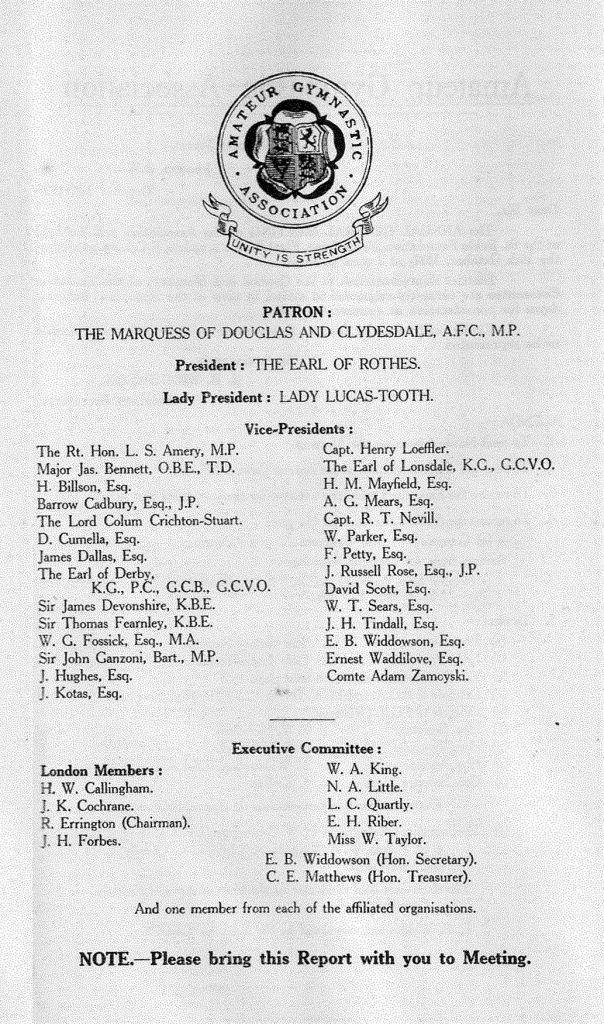
Above - The 1937 annual report showing nine London members, including Miss Taylor
Twenty-one lady gymnasts travel to Ostend for the Belgium Festival
In June, two teams of lady gymnasts, twenty-one in total, travel to Ostend for the Belgium Festival, representing the north and south of England. The programme includes five apparatus for the individual competition, team exercise in rhythmic exercise, national dances, and fancy dress. Mrs Carrie Pollard (North) and Mr Bill King (South) are the two instructors.

Above - The 1938 Ostend gym festival
England beats Wales in a men's international at Swansea
A men's international contest takes place between Wales and England in Swansea. England wins, but Wales is handicapped as multiple British Champion Arthur Whitford is injured and unable to complete his routines.
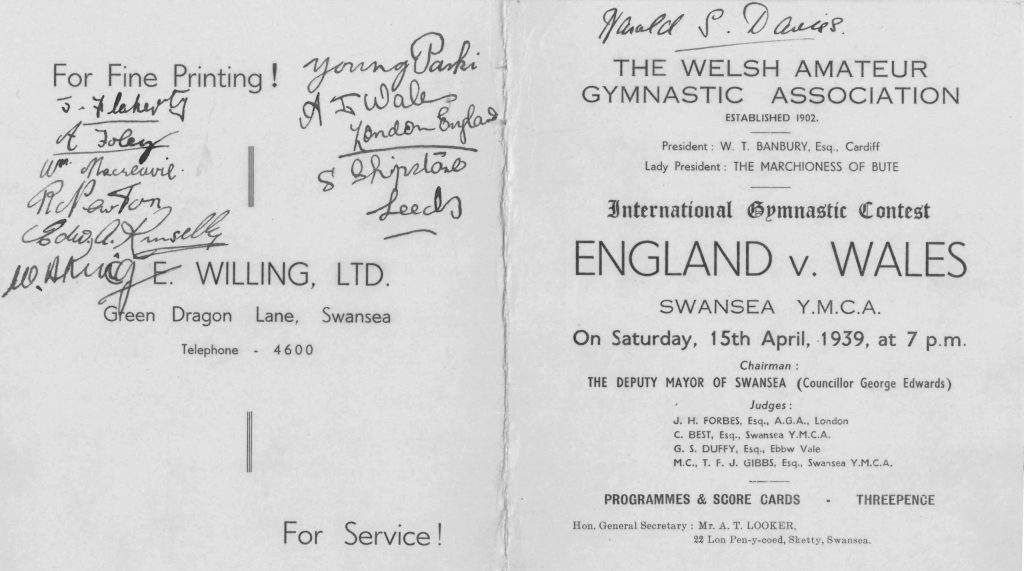
Above - Programme, England v Wales at Swansea YMCA, April 1939, part of the Harold Davies archive
Pre 1900 | 1900 to 1939 | 1940 to 1980 | 1981 to present
The content on this site is curated by Meg Warren, with assistance from Warren Slingsby and a small but dedicated team of contributors. We are building a comprehensive history of gymnastics in Britain and are always interested in learning more and gathering more historical content, so if you can contribute to this page or any others, please get in touch with the links below. Read about the contributors.

Est. 2018 | © GymnasticsHistory.co.uk 2026