
HISTORY OF BRITISH GYMNASTICS
From a period of austerity, typified by the 1948 London Olympics, the AGA battled against all odds to survive, reliant on volunteers. The profile of Gymnastics improves with sponsorship and the staging of international events, and coaches make their own way with the coming of the private gym clubs.
Pre 1980
Two GB teams compete at the 1948 London Olympics, training in Hyde Park with help from a German POW
1948 Olympic Games in London - 2 teams represent GB. Much of their training is done in poor conditions, including in Hyde Park. German POW Helmut Bantz helps the men's team with their training.
The first residential gymnastics course is held at Bisham Abbey, running for the next 15 years
The first residential gymnastic course is held at Bisham Abbey, which continued for 15 years.
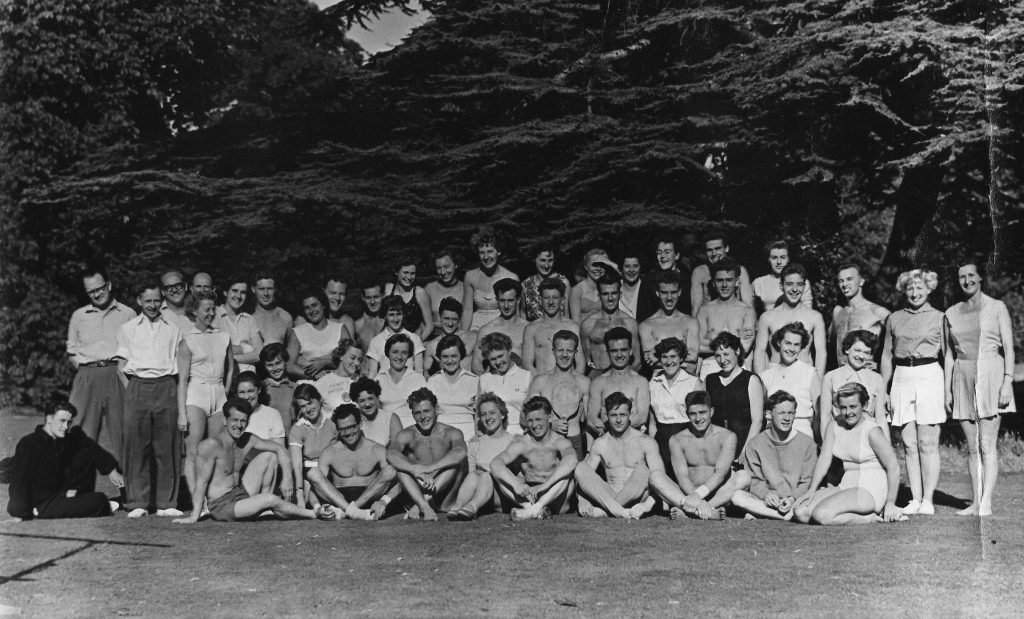
Above - Bisham Abbey course circa 1957
The British team trains at Bisham Abbey ahead of the 1952 Helsinki Olympics
The British team trains at Bisham Abbey prior to the 1952 Olympics in Helsinki.
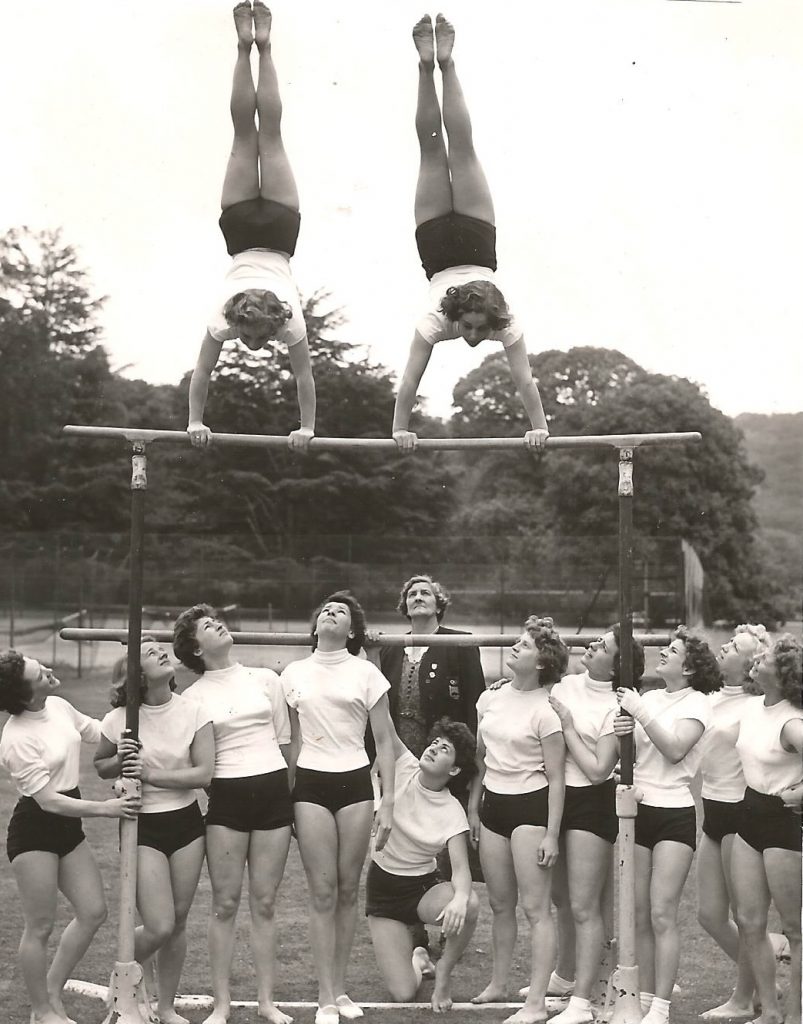
Above - 1952 Olympic women hopefuls at Bisham
A Welsh team attends the first ever Gymnaestrada, in Rotterdam
A Welsh team attends the 1st ever Gymnaestrada, in Rotterdam.
GB play Germany at Harringay Arena in North London; the event is a financial disaster.
Frank Edmonds becomes honorary secretary of the AGA
Frank Edmonds becomes honorary secretary of the AGA, working from his home in London.
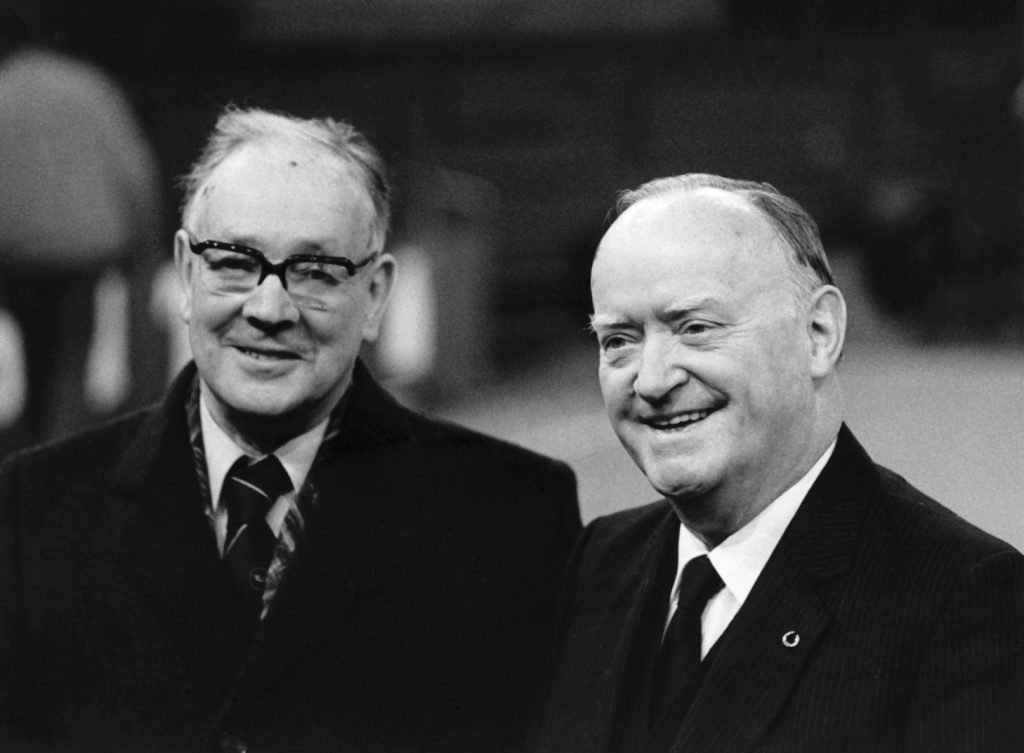
Above - Frank Edmonds, President of British Gymnastics, with Max Bangerter, Secretary General of the FIG
The first evidence emerges of formal coaching examinations
Evidence of coaching examinations taking place, in this case for the Intermediate Diploma in Coaching awarded by the Amateur Gymnastics Association.
A Welsh team takes part in the Gymnaestrada in Zagreb.
The Championships of North West Europe are held at Nottingham Ice Rink
The Championships of North West Europe are held at Nottingham Ice Rink; the event is another financial disaster.
The Gymnast magazine is re-introduced, edited by Jim Prestidge
The Gymnast magazine is re-introduced. The editor is Jim Prestidge.
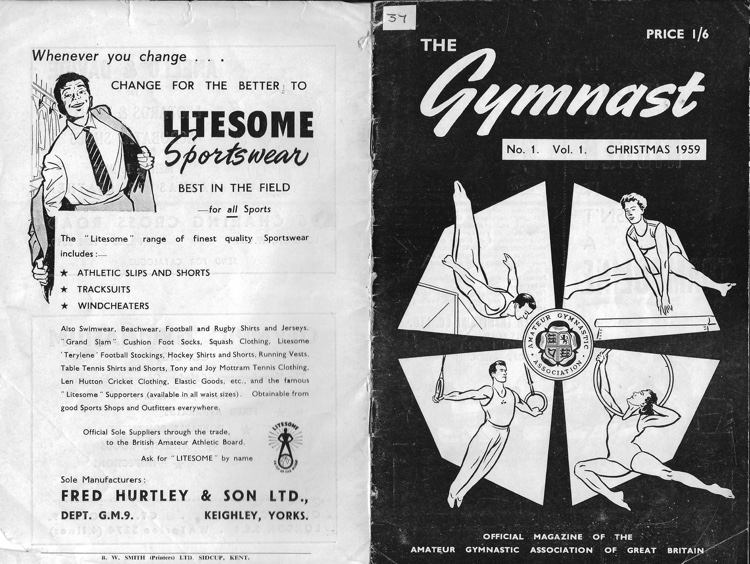
Above - The Gymnast magazine, re-introduced in 1959
Two full teams head to the Rome Olympics after their coaches lose funding and pay their own way
Two full teams are selected for the Olympics in Rome. At the last minute, funding is withdrawn for the two coaches, Frank Turner and Edna Gross; they pay their own way.
The first schoolboys course is held at Swaylands, Kent.
London, Manchester and Liverpool YMCAs and The London Gym Club - a total of 65 male gymnasts - perform before the FA Cup at Wembley on high bar, two vaulting tables and floor work with hand balancing, on 23rd April.
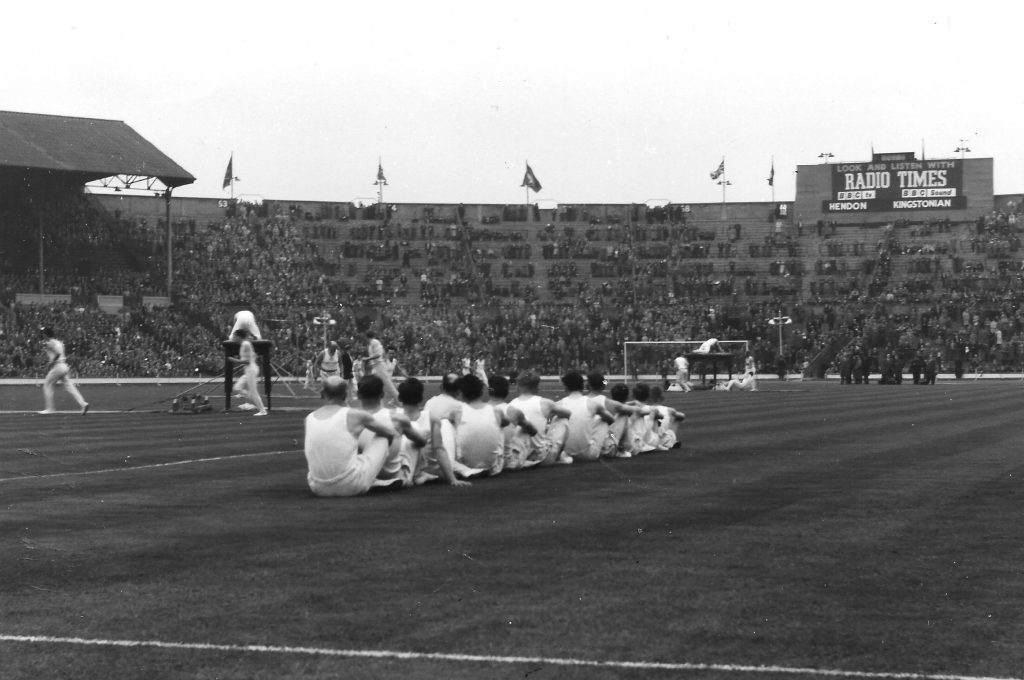
Above - Gymnastics display before the FA Cup at Wembley
The first British Championships are held at a major venue, the Royal Albert Hall
The 1st British Championships are held at a major venue, The Royal Albert Hall. The event is over-subscribed, with an audience of 6,000 plus standing room. This event continues until 1971, before changing to the Champions Cup, which continued at the Albert Hall until 1974, by which time the venue had really become unsuitable for such an event.
British Championships for Men's Trampoline take place at the Albert Hall, alongside MA and WA.
The Proficiency Award Scheme is set up; 1,000 gymnasts participate, but only 60 schools take part.
GB enters the European Championships for women for the first time, held in Leipzig, East Germany.
GB is represented at the Gymnaestrada in Stuttgart by a Welsh team, Fulwell School (Monica Rutherford's school), Bexley Girls Gym Club and Openshaw Technical School, Manchester.
700 people now subscribe to The Gymnast magazine
700 people subscribe to The Gymnast magazine.
Women trampolinists take part in the British Championships at the Albert Hall.
The Amateur Gymnastics Association is renamed the British Amateur Gymnastics Association
The Amateur Gymnastics Association, seen as the governing body for the UK, becomes the British Amateur Gymnastics Association.
Regional boundaries are redrawn in line with the Central Council for Physical Recreation.
Nik Stuart becomes the first paid National Coach as the first World Trampoline Championships are held in London
Nik Stuart retires from competitive gymnastics and becomes the first paid National Coach for the BAGA.
Jim Prestidge becomes the first paid general secretary for the BAGA, working from head office at Park Crescent Central, London.
The First World Trampoline Championships take place at the Albert Hall, promoted by the Nissen Corporation USA in conjunction with Nissen GB and the BAGA.
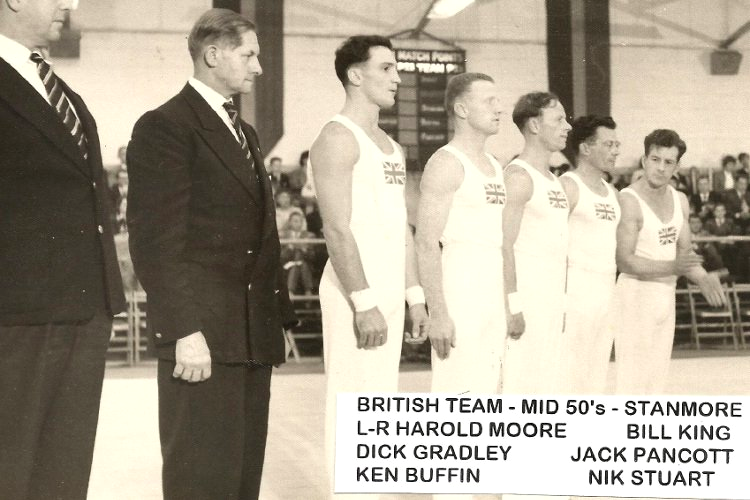
Above - Nik Stuart in 1964 - from far right Nik Stuart, Jack Pancott, Bill King, Ken Buffin, Dick Gradley
400 British gymnasts take part in the Vienna Gymnaestrada
400 gymnasts from all parts of the country take part at the Vienna Gymnaestrada.
The Perfectionists visit by Soviet gymnasts takes place at Crystal Palace; the BBC films the event.
Britain's men and women compete at their first ever World Championships, in Dortmund
Men and women take part in their first ever World Championships, in Dortmund. Both teams travel by minibus and stay in unofficial accommodation, as the official 4-star hotel is too expensive.
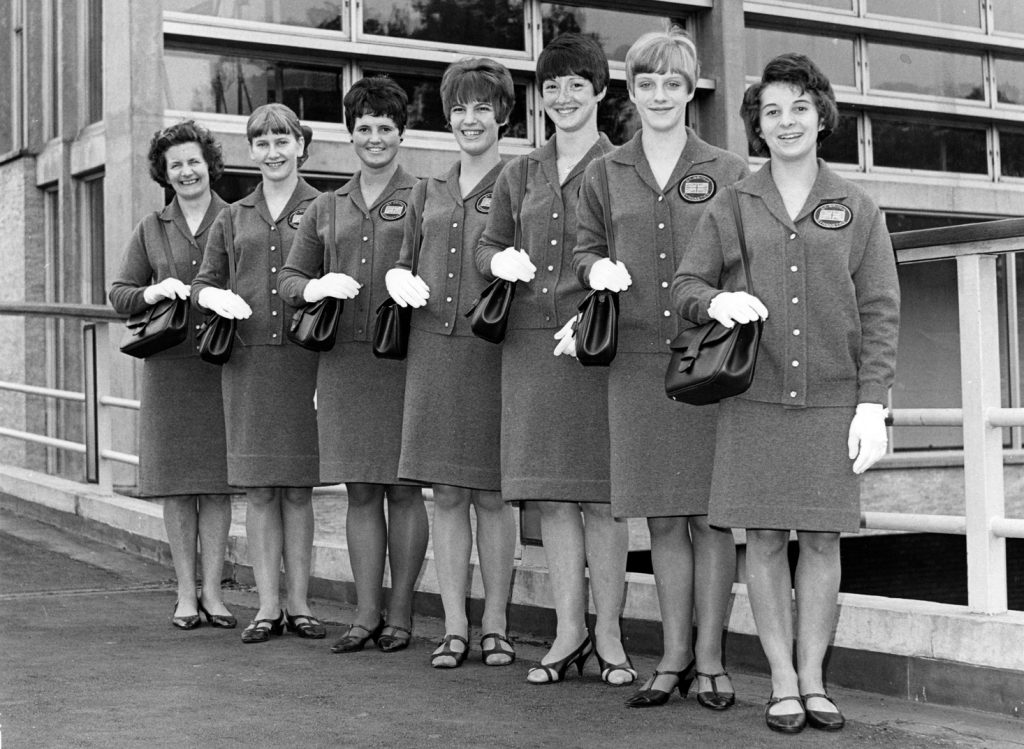
Above - The first British women's team to compete in a World Championships, before leaving for Dortmund - left to right Pauline Prestidge (coach), Mary Prestidge, Ann Simmons, Diane Lodge, Rita Francis, Maria Gough, Margaret Bell
The first Champions All event is held at Fairfield Halls, Croydon
A large British team takes part at the Basle Gymnaestrada.
The first Champions All event is held at Fairfield Halls, Croydon.
The first National Judges Women's Artistic gymnastic course is held, a course and examination for Area and National judges.
Gymnastics for Youth, a national boys' course, takes place at Luton Youth Centre, bringing together leading men's coaches as well as gymnasts.
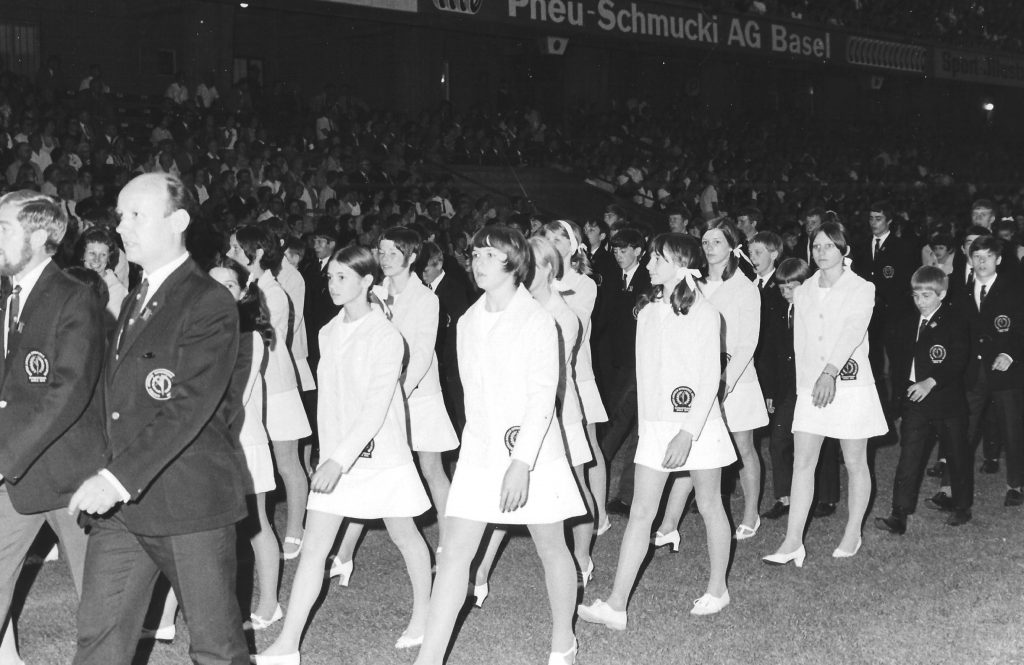
Above - Gymnaestrada, Basle, 1969
The first National Conference brings together the Board of Control, regional secretaries and technical committees
The first National Conference takes place, involving Board of Control members, regional secretaries and members of the technical committees.
The Girls 3 Year Plan has to be divided into North and South to cope with demand, with a record entry of 300 gymnasts.
Club membership averages between 30 and 100 members. BAGA membership fees amount to £677.16, with affiliation fees of £12,500.
A Men's Artistic Judging course and examination is held.
The Sunday Times sponsors a new £25,000 award scheme and the Champions All event
The Sunday Times Award Scheme is set up, a £25,000 sponsorship deal with the BAGA - a badge scheme designed to introduce young children to the sport of gymnastics through floor and vault. Six months later the 100.00 award is given.
An annual coaching course in WA sees 11 club coaches and 5 assistant coaches receive their awards. WA gymnastics has a total of 70 assistant coaches, 200 club coaches and 4 senior coaches, plus 6 honorary coaches; the level of Area coach is introduced.
BAGA fees: life membership £22.50, annual membership £2.50, junior £1.25, and 50p for school members.
The Sunday Times sponsors Champions All at the Crystal Palace, with highlights shown on BBC Grandstand the following week.
A national syllabus is set for coaching in men's and women's artistic gymnastics; prior to this, although exams took place, the syllabus seemed very haphazard.
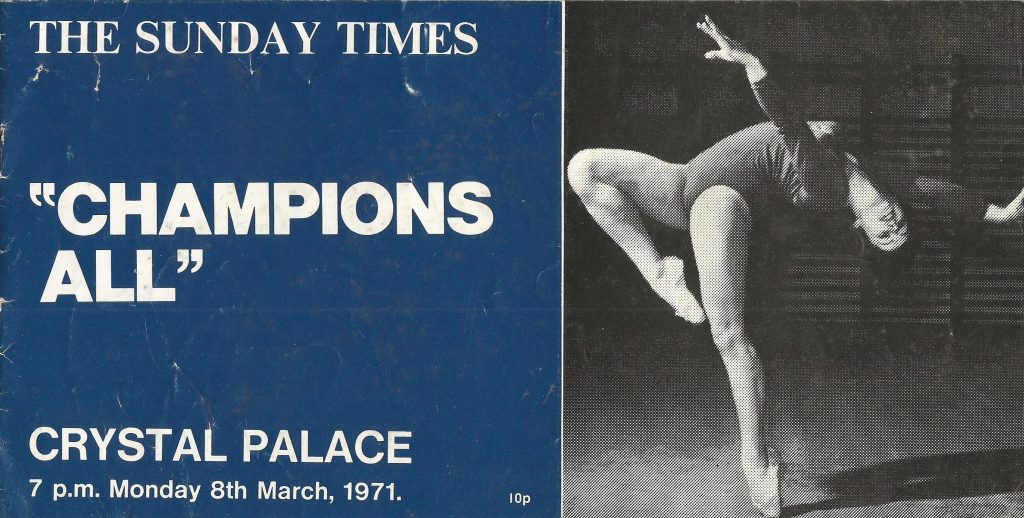
Above - Champions All 1971 programme
The Champions All event moves to Fairfield Halls, where vault is dropped from the programme
The Champions All event is held at Fairfield Halls. Because of the constraints of the venue, vault is omitted from the men's and women's programmes.
The British Championships for Men and Women are held at Darlington, with room for only 300 spectators. The event at the Albert Hall is now the Champions Cup.
A record entry of 470 girls takes part in the 3 Year Programme of set exercises, introduced by the Women's Technical Committee in 1969.
The European Championships for Women sell out Wembley's Empire Pool
The 9th European Championships for Women are held at the Empire Pool, Wembley - it's a sell-out.
3 National Coaches are appointed: John Atkinson, Mick Haynes and Margaret Tipping.
Tony Murdock is appointed to the new post of Director of Development.
Russian displays are held at the Empire Pool.
300 girl gymnasts attend a residential schoolgirls' course at the Sobell Centre, Islington, London; gymnasts are accommodated at Goldsmiths College, South London, with 6 sets of apparatus set up at the venue.
The Boys 5 Year Plan is introduced.
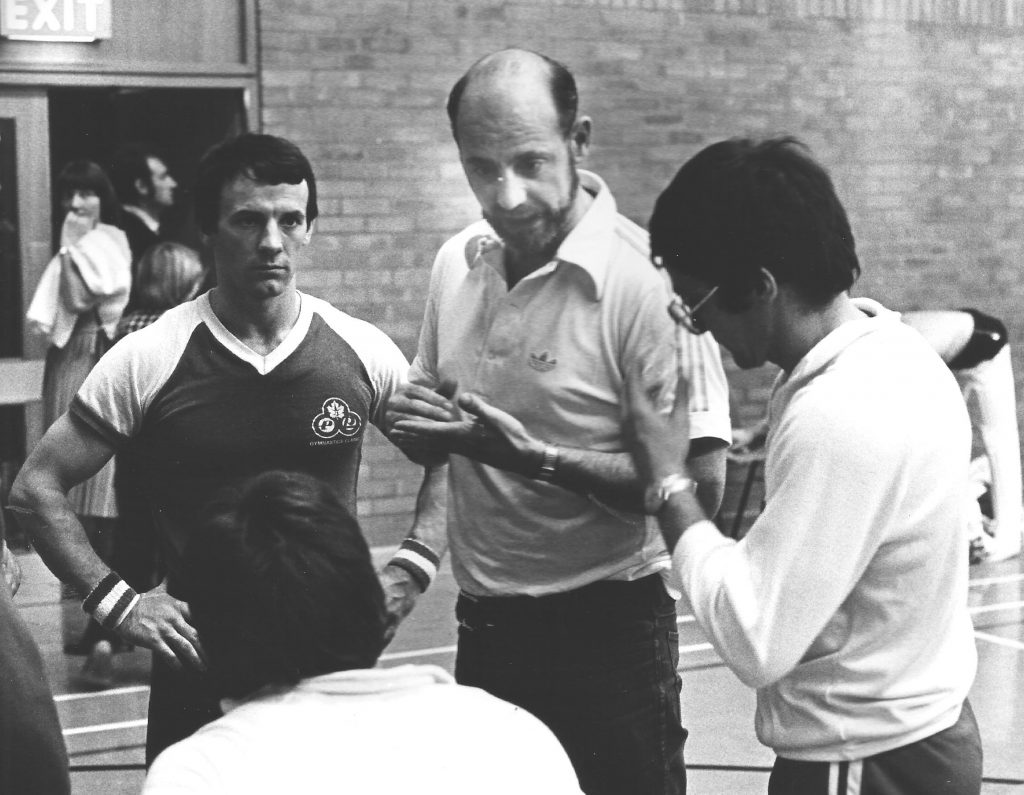
Above - John Atkinson with Jeff Davis and Mitch Fenner
The first UK course in Gymnastique Moderne draws 90 gymnasts and 25 coaches
The first course held for Gymnastique Moderne in the UK (Rhythmic gymnastics); 90 gymnasts attend along with 25 interested coaches.
Morgan Smith and Jeff Davis excel at the 1st IFSA World Acrobatic Competition.
The Asymmetric Bars famously collapse mid-routine at the first World Cup event, held at Wembley
The 1st World Cup event is held at Wembley's Empire Pool. This is the famous event where the Asymmetric Bars collapsed as Ludmilla Tourischeva finished her exercise.
The 1st assistant National Coaches Conference for men is held at Lilleshall.
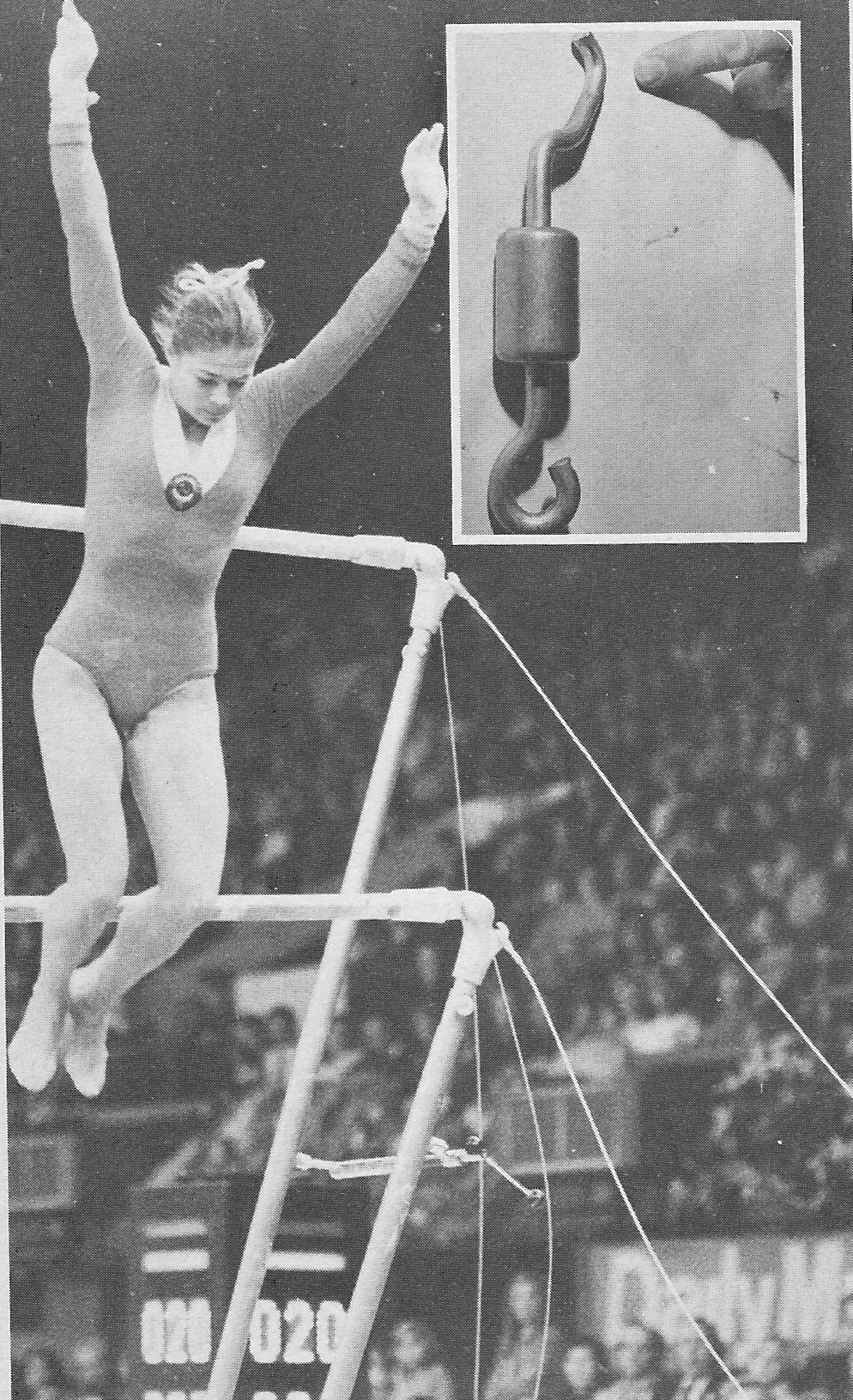
Above - The Bars famously collapse at the end of Tourischeva's bar routine
The first Coca-Cola International is held in Brighton as pits first appear in UK clubs
The first Coca-Cola International is held at Brighton, in December.
The first pits appear in UK clubs.
Annette Stapleton becomes Women's Director of National Training.
Leeds Athletic Institute win the Adams Shield (British Team Championship) with disabled team member Jim Brogan.
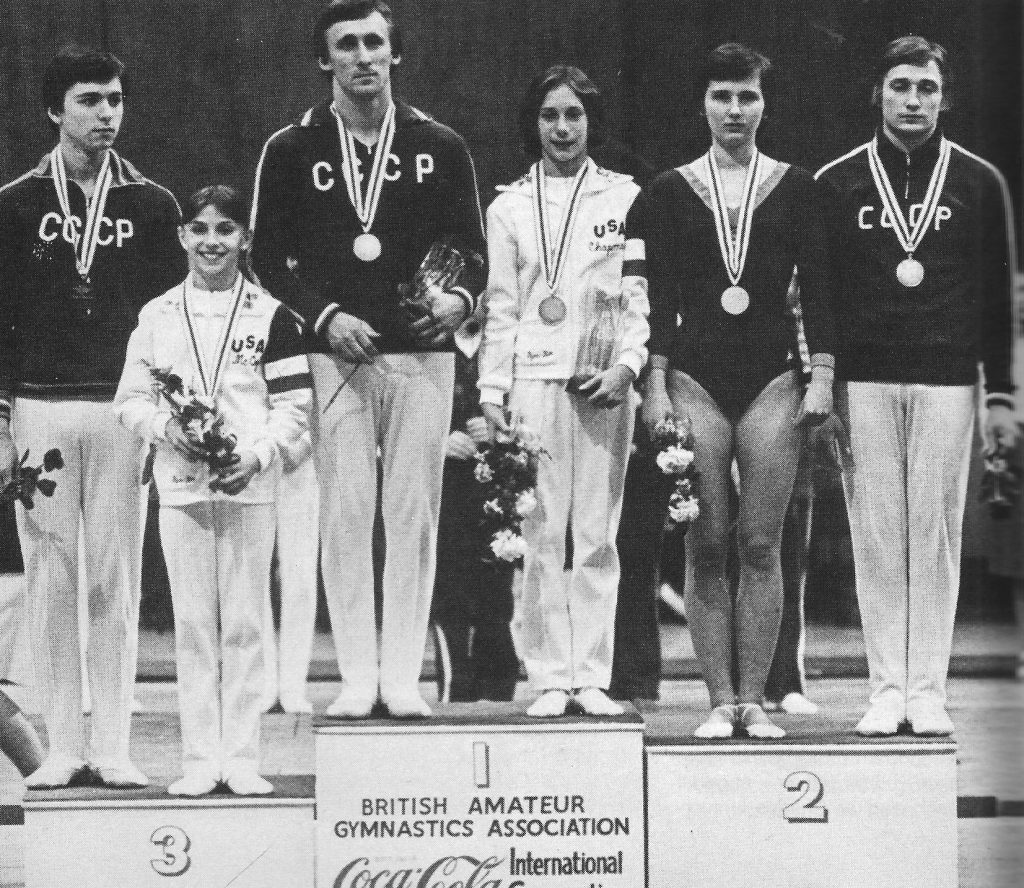
Above - The 1st Coca-Cola Championships, Brighton, 1977
Over two million Sunday Times Award scheme badges have now been issued
Over 2 million Sunday Times Award scheme badges have been issued, including growth in the number of disabled children taking part.
Entries to the Girls NDP competitions have grown six-fold, meaning around 1,800 gymnasts. BAGA membership has also grown six-fold.
The number of gymnasts in the London area is estimated to have risen from 1,500 in 1967 to 8,000.
Administration of women's coaching awards is centralised at Lilleshall following a national workshop for coaching examiners; within a year the number of coaches doubles, and a list of recognised examiners is set up (previously, coach examination could be done at a national course, or within the regions by asking another coach of a higher level to examine candidates).
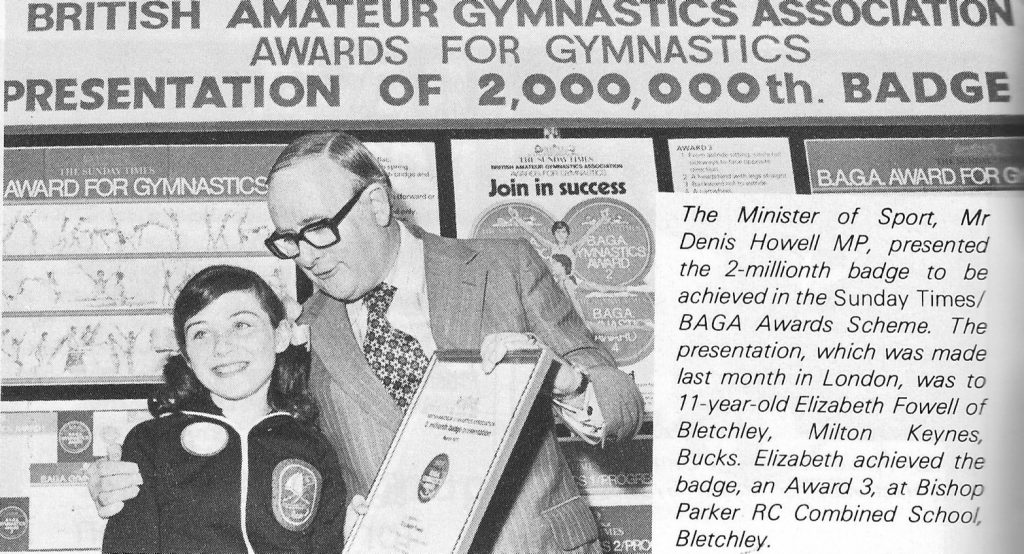
Above - 2,000,000 Sunday Times Gymnastics Award Scheme badges
Obligatory individual gymnast membership is introduced
Obligatory individual gymnast membership is introduced. All affiliated clubs had to register all individual members, a huge change to the finances of the BAGA. A national insurance scheme is also introduced (approx. year 1980).
Pre 1900 | 1900 to 1939 | 1940 to 1980 | 1981 to present
The content on this site is curated by Meg Warren, with assistance from Warren Slingsby and a small but dedicated team of contributors. We are building a comprehensive history of gymnastics in Britain and are always interested in learning more and gathering more historical content, so if you can contribute to this page or any others, please get in touch with the links below. Read about the contributors.

Est. 2018 | © GymnasticsHistory.co.uk 2026