
HISTORY OF BRITISH GYMNASTICS
There are glimmers of hope with reorganisation and professional staffing. Equipment and facilities are improving in quality and quantity, and gymnastics coaches take up the challenge. With funding from outside bodies, British Gymnastics finally competes on equal terms, displaying our wealth of talent.
1981 to Present
The FIG celebrates its centenary as the Sports Acrobatics Award Scheme passes 50,000 badges
The International Gymnastics Federation (FIG) celebrates its centenary.
The Sports Acrobatics Award Scheme reaches 50,000 badges by December.
The Men's Artistic Award Scheme is launched
The Men's Artistic Award Scheme is launched in January.
The BAGA's technical administration is established at Lilleshall
The BAGA's technical administration is established at Lilleshall; the other part of the BAGA remains at Slough.
GB competes at the Los Angeles Olympics as Disability Gymnastics is recognised as an official discipline
Los Angeles Olympics - 2 teams of 6 take part, plus 2 rhythmic gymnasts.
GB men and women gymnasts also participate in the Alternative Olympics in Czechoslovakia (the Eastern Bloc Olympics, held after they boycotted Los Angeles).
British Gymnastics aims to give all disabled people, regardless of impairment or ability, the chance to participate in every form of the sport; Disability Gymnastics is recognised as an official discipline.
John Atkinson is appointed Technical Director. Colin Still becomes full-time National Coach for women, a post he had held in an honorary capacity since 1981. Lloyd Readhead is appointed as National Coach for men.
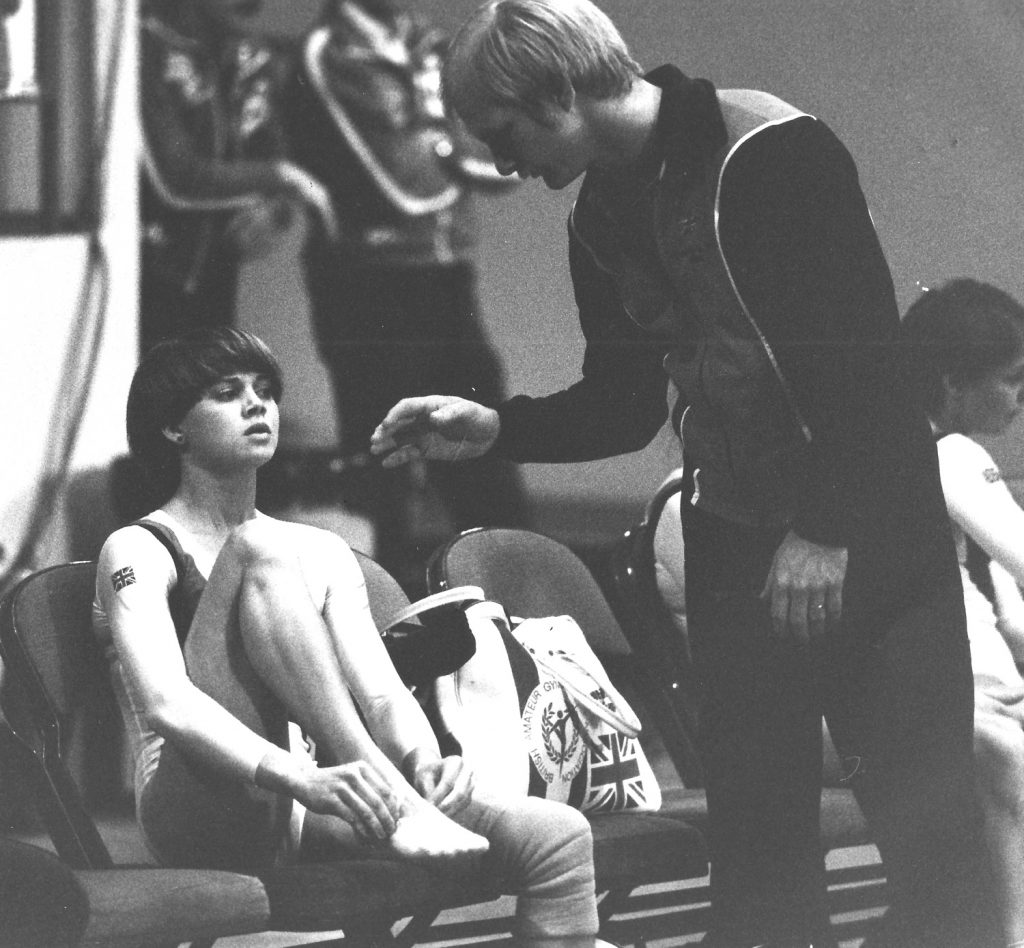
Above - Susan Cheesebrough with Colin Still at the World Championships
A new generation of national coaches is appointed across the disciplines
Eddie Van Hoof becomes a national coach for men. Wolfgang Bohner is appointed a national coach for women. John White is appointed National Coach for Recreational Gymnastics. Helen Roberts is appointed as National Rhythmic Gymnastics Coach.
An English committee is formed to select teams for the Commonwealth Games
An English committee is formed to support and select gymnasts for Commonwealth Games teams. The 1986 Commonwealth Games in Edinburgh did not include gymnastics, so a Commonwealth Gymnastics Championships took place at Falkirk instead, with teams from Scotland, Wales and England plus other Commonwealth countries.
The BAGA celebrates its centenary with a mass display at Wembley Arena
The BAGA celebrates its centenary year with a mass display at Wembley Arena.
Seoul Olympics - 2 women and 2 men take part, plus 1 rhythmic gymnast.
Princess Anne opens the new dedicated gym at Lilleshall.
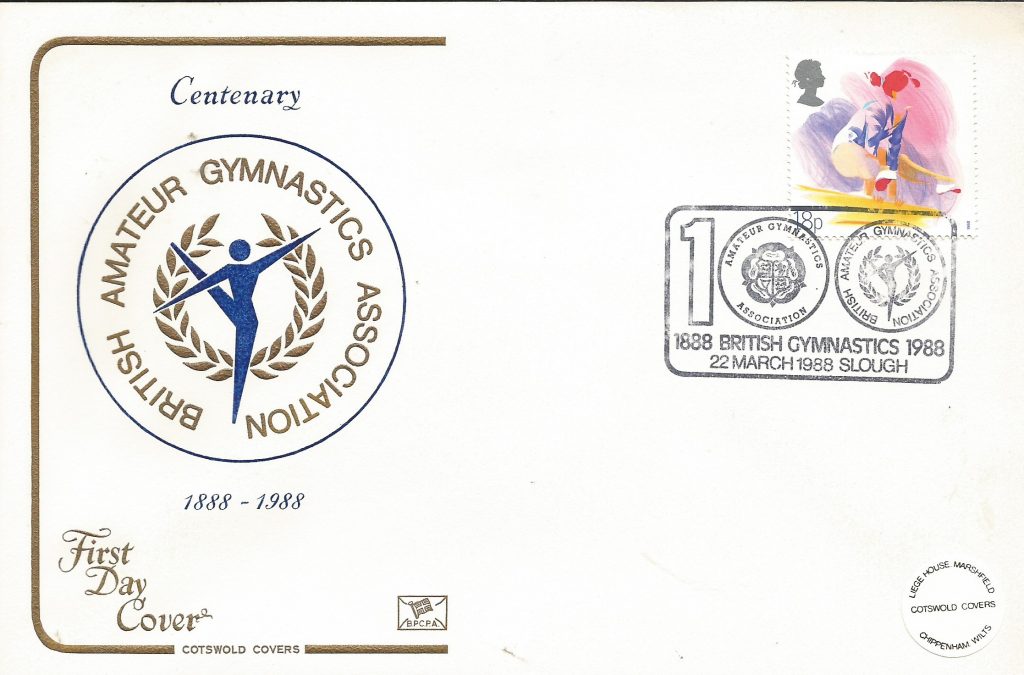
Above - BAGA Centenary stamp, 1988
Mathew Todorov's appointment as National Coach proves a turning point for Acrobatic Gymnastics
Mathew Todorov from Bulgaria is appointed National Coach for Acrobatic Gymnastics; this proves to be a turning point for the discipline.
GB competes at the Barcelona Olympics as Aerobic Gymnastics is introduced in Great Britain
Barcelona Olympic Games - a team of 6 men and 2 women represents GB.
Some male gymnasts are centralised, training at Lilleshall. Adrian Stan from Romania is appointed National Coach for women's artistic gymnastics.
Aerobic Gymnastics is introduced in Great Britain.
Neil Thomas wins Britain's first ever World medal in artistic gymnastics, at the Birmingham World Championships
Birmingham hosts the first Artistic World Championships in Britain. Neil Thomas wins the silver medal on floor exercise, the first World medal for the UK in artistic gymnastics.
Adrian Stan increases the difficulty of the range and condition exercises for the Women's NDP, which begins to revolutionise performances within women's gymnastics.
The first closed English Championships is held in Liverpool for men's and women's artistic gymnastics; the Open Championships of England, running since 1896, had always been the opportunity for all UK gymnasts to take part, and now takes on the mantle of The British Championships.
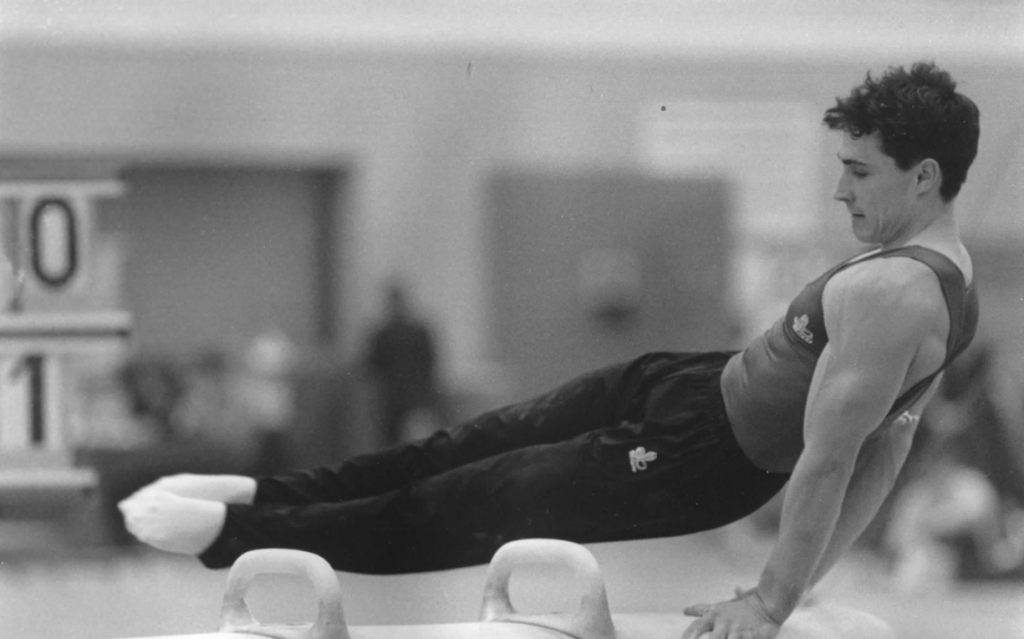
Above - Neil Thomas, 2x British Gymnastics Champion and Britain's first World Championships silver medallist
Association membership falls below 60,000
Membership within the association falls below 60,000.
GB competes at the Atlanta Olympic Games
Atlanta Olympic Games - 2 men and 2 women represent GB.
Glasgow hosts what becomes Britain's annual World Cup gymnastics event
British Gymnastics is awarded the rights to host one of the prestigious Artistic Gymnastics events - originally called a Grand Prix, now called a World Cup. This is held in Glasgow, which goes on to host numerous Grand Prix events - a televised, international competition featuring the world's best gymnasts, still held in Britain each year.
UK Sport begins awarding Lottery funding to British Gymnastics
UK Sport begins awarding Lottery funding to British Gymnastics for the development of elite sport programmes.
The British Trampoline Federation joins British Gymnastics ahead of the Sydney Olympics
The British Trampoline Federation joins British Gymnastics, uniting the disciplines ahead of the 2000 Olympics. The BTF was formed sometime in the 1960s.
Alan Somerville becomes CEO and turns around British Gymnastics' finances
Sydney Olympic Games - a team of 6 women and 1 man represents GB.
Alan Somerville becomes CEO of British Gymnastics following a variety of General Secretaries. BG's finances are in a poor state; Alan Somerville turns this around.
British Gymnastics membership is now up to 100,000.
Beth Tweddle wins Britain's first ever women's artistic bars medal at the European Championships
Beth Tweddle wins a bronze medal on bars at the European Championships - the first ever for a British women's artistic gymnast. At the Commonwealth Games in the same year she wins gold for England on the bars.
Beth Tweddle wins Britain's first World medal for a female artistic gymnast
The first World medal for a British artistic woman: Beth Tweddle wins bronze on the bars at the World Championships.
John Atkinson retires from British Gymnastics as men's Performance Director.
GB competes at the Athens Olympic Games
Athens Olympic Games - a team of 6 women represents GB.
Britain is announced as host for the 2012 Olympic Games
Britain is announced as host for the 2012 Olympic Games. British Gymnastics launches a new strategy to host a European or World Championships each 4-year Olympic cycle.
Beth Tweddle becomes World Champion on bars for the first time
Beth Tweddle becomes World Champion on bars for the first time, at the World Championships in Aarhus, Denmark.
Eddie Van Hoof becomes men's national coach for the second time.
Dan Keatings wins silver on pommel horse at the European Championships
Dan Keatings wins the silver medal on pommel horse at the European Championships.
Louis Smith wins Britain's first individual Olympic gymnastics medal in a century, 100 years after Walter Tysall
Beijing Olympics - a team of 6 women and 2 men represents GB. 100 years after Walter Tysall won a silver medal, Louis Smith wins Britain's next Olympic medal, taking bronze on pommel horse.
The Junior men's team wins gold at the European Championships, beating Russia.
Dan Keatings and Beth Tweddle both medal at the World Championships in London
Dan Keatings wins silver in the all-around at the World Championships in London; Beth Tweddle wins the floor exercise.
Beth Tweddle wins gold on the bars at the European Championships.
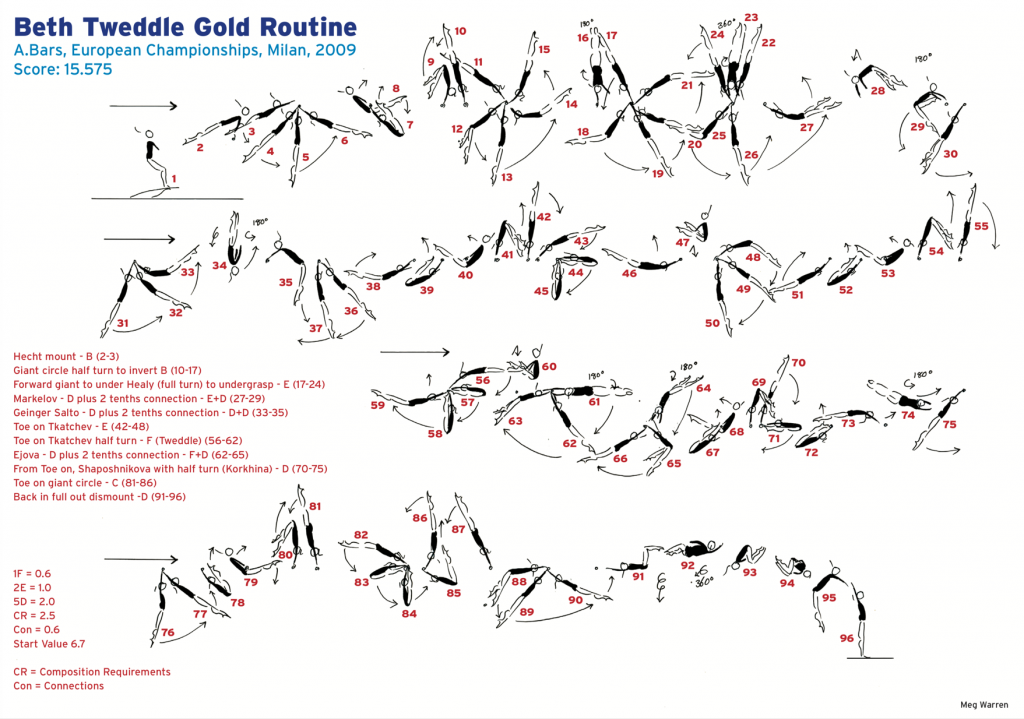
Above - Beth Tweddle's bars gold medal routine, 2009 European Championships
Sam Oldham takes Junior European gold as the senior women's team wins silver, both in Birmingham
Sam Oldham wins gold in the all-around at the Junior European Championships in Birmingham, with Max Whitlock winning silver.
The senior women's team takes the silver medal at the European Championships in Birmingham, with Beth Tweddle winning the individual bars and floor championships.
GB men win bronze at the London Olympics as gymnastics membership passes 300,000 for the first time
The senior British men's team wins gold at the European Championships.
The Olympic Games is held in London, with gymnastics at the North Greenwich Arena. GB men win bronze in the team event. This is followed by 3 individual medals: silver and bronze for Louis Smith and Max Whitlock on pommels, and bronze for Beth Tweddle on bars. Behind the scenes, British Gymnastics' events team runs the gymnastics competitions at the North Greenwich Arena (the O2 Arena) and Wembley Stadium for the Rhythmic Gymnastics.
British gymnasts are now more popular than at any other time in our history; TV audiences are higher than ever, and our top gymnasts achieve recognition off the competition floor.
Gymnastics as a sport is more popular than ever, and membership numbers exceed 300,000 for the first time.
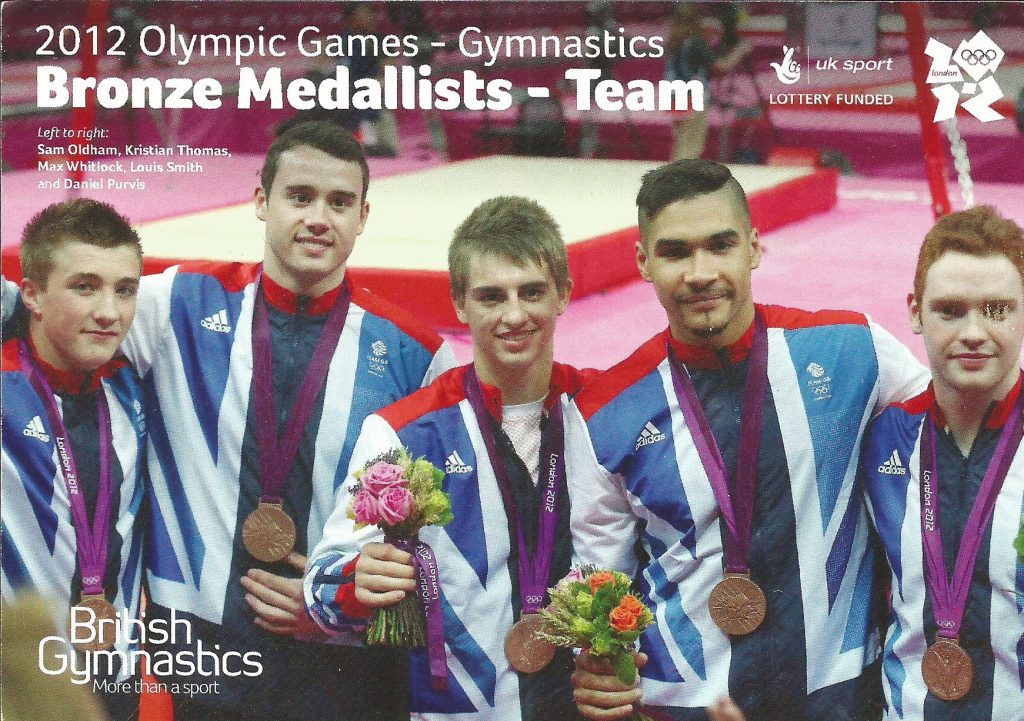
Above - 2012 Olympics GB men's team, bronze
Max Whitlock wins World silver as the British Gymnastics Foundation launches
Max Whitlock wins the silver medal in the all-around competition at the World Championships.
Launch of the British Gymnastics Foundation, which aims to help the underprivileged.
Max Whitlock wins pommel horse gold as GB men take World Championship team silver in Glasgow
British Gymnastics is recognised as a leader in Disability Gymnastics, and is invited to train other nations on delivery of the sport.
GB men take the silver medal in the team competition at the World Championships in Glasgow.
Max Whitlock wins gold on the pommel horse at the World Championships.
GB wins 2 golds at the Rio Olympics as British Gymnastics is named Governing Body of the Year
Rio Olympic Games - GB wins 2 gold medals: Max Whitlock wins floor exercise and pommel horse. Louis Smith wins silver on pommels, Amy Tinkler wins bronze on floor and Nile Wilson wins bronze on high bar. Max also wins bronze in the all-around, and Bryony Page wins silver on trampoline.
British Gymnastics wins the Governing Body of the Year award.
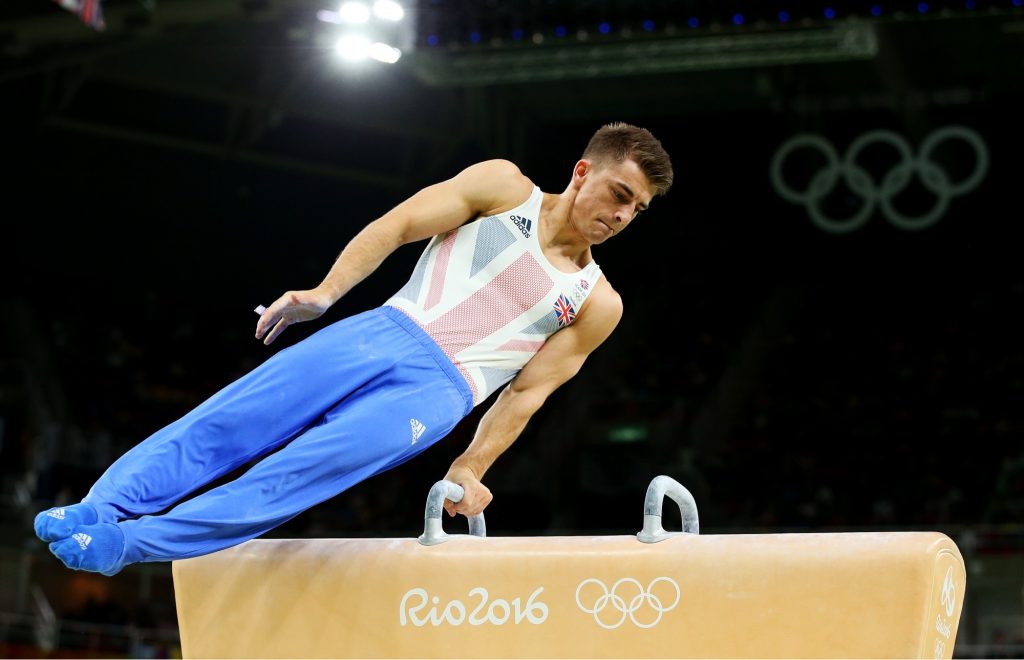
Above - Max Whitlock going for glory in Rio, with his third medal
Max Whitlock successfully defends his pommel horse world title in Montreal
Max Whitlock successfully defends his title as world champion on pommel horse, at Montreal.
Joe Fraser becomes Parallel Bars World Champion as Max Whitlock retains his pommel title
Joe Fraser becomes Parallel Bars World Champion at the World Championships in Stuttgart, Germany.
Max Whitlock retains his Pommel Horse World title. Becky Downie wins silver on Uneven Bars and bronze on Vault.
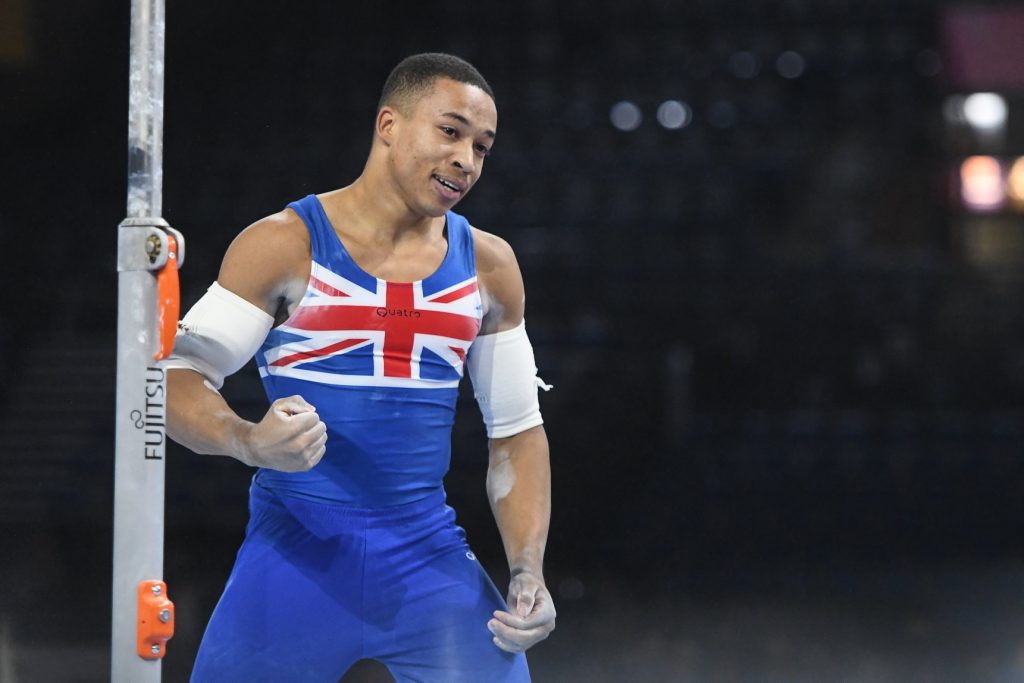
Above - Joe Fraser, Parallel Bars World Champion, 2019
The women's team takes bronze for the first time since 1928 as Max Whitlock wins a third straight Olympic pommel gold
The 2020 Tokyo Olympic Games are delayed and take place in 2021 because of the COVID-19 pandemic.
The women's artistic team wins bronze for the first time since 1928.
Max Whitlock wins gold again on the pommels, making him a 3-time medal winner at three consecutive Olympics on the Pommel Horse.
Bryony Page wins the bronze medal in the women's trampoline event at the Tokyo Olympics, making her a 2-time Olympic medallist. She also becomes the 2021 World Champion, making her the first world champion in this discipline and our most successful trampoline gymnast.
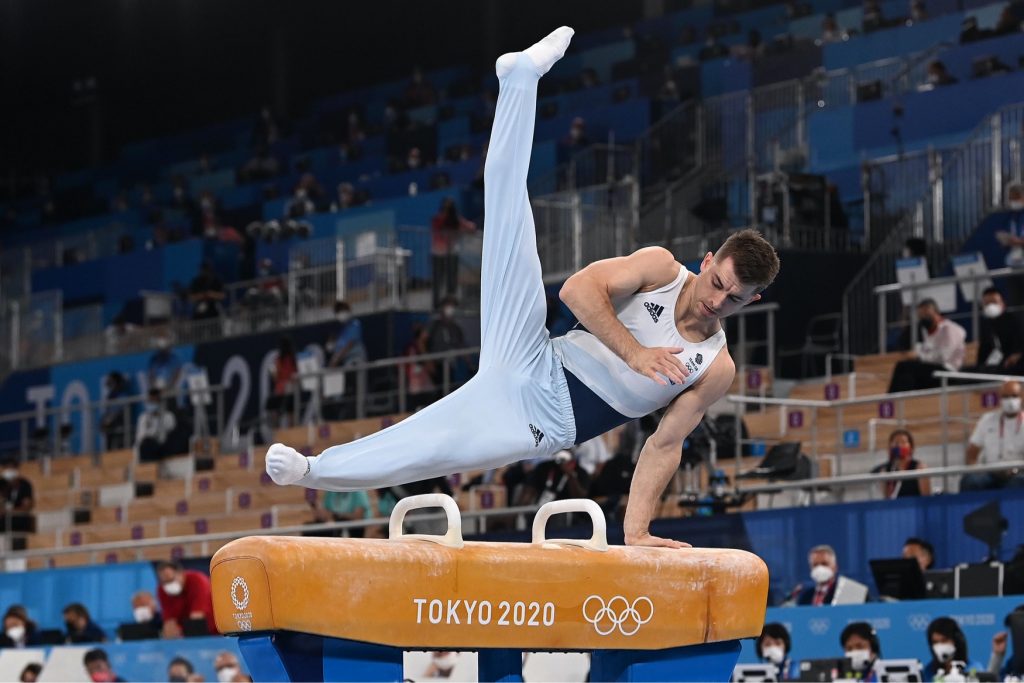
Above - Max Whitlock winning Pommel at the Tokyo 2020 Olympics - courtesy Garry Bowden, Sport in Pictures, British Gymnastics
Great Britain wins an unprecedented 6 medals at the World Championships in Liverpool
Great Britain wins an unprecedented 6 medals at the World Championships, held in Liverpool between 29th October and 6th November 2022. The GB Women's Team wins silver in the team competition, and the Men's Team then wins bronze, meaning both teams qualify for the Paris 2024 Olympics - GB is the only country to manage full qualification at this stage. This is followed by Jessica Gadirova winning All-Around bronze, Courtney Tulloch winning bronze on the Rings, and Giarnni Regini-Moran and Jessica Gadirova both becoming Floor World Champions.
GB wins gold at the European Teamgym Championships in Luxembourg. The team of Connor Wharram, Jenson Hazel, Katelyn Little, Yasmin Parker, Lewis Lakin, Lewis Clothier, Lucas Jones, Lucy Bonwell, Naomi Bostock, Nicole Hazell, Chris Cranfield and Katie Iles scores 56.350 from floor (18.000), tumble (19.600) and trampette (18.750).
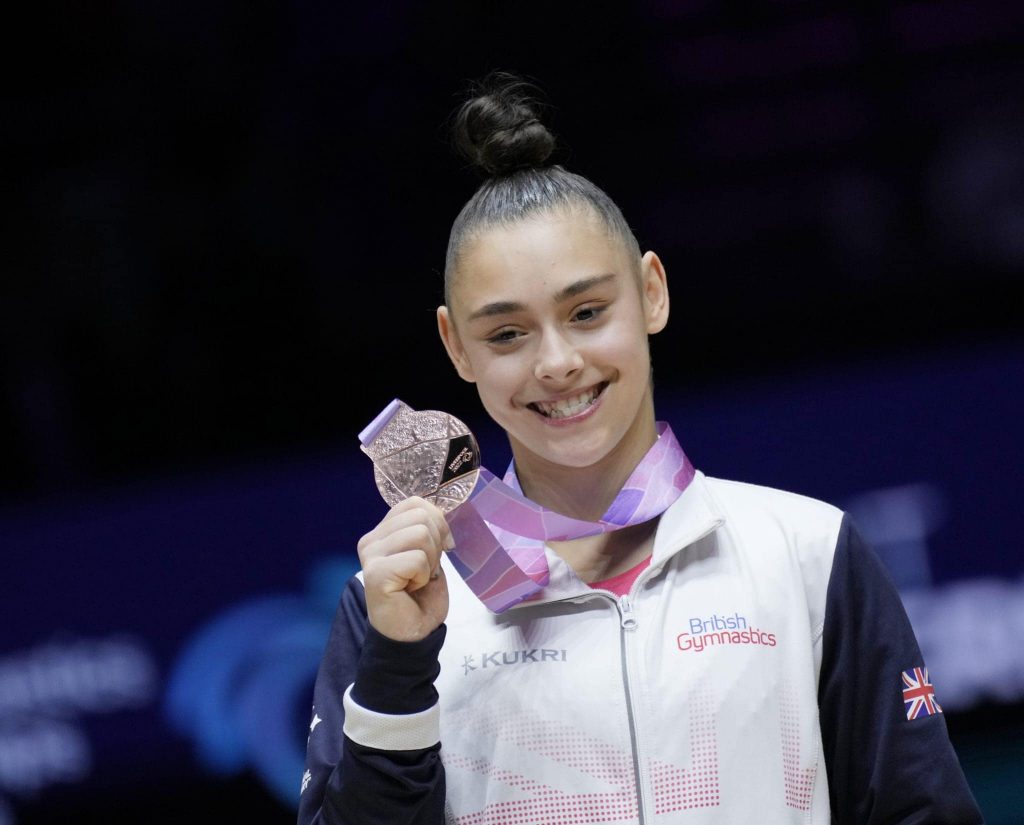
Above - Jessica Gadirova winning All-Around bronze at the World Championships, 2022
Pre 1900 | 1900 to 1939 | 1940 to 1980 | 1981 to present
The content on this site is curated by Meg Warren, with assistance from Warren Slingsby and a small but dedicated team of contributors. We are building a comprehensive history of gymnastics in Britain and are always interested in learning more and gathering more historical content, so if you can contribute to this page or any others, please get in touch with the links below. Read about the contributors.

Est. 2018 | © GymnasticsHistory.co.uk 2026